
Understand scores and risk
Scores help you choose projects for a closer look.
How to use it
- Check the game's score, risk and confidence beside the result.
- Open the score explanation and review strengths and weaknesses.
- Compare the score with the audience chart and game changes.
Advice and practical context
Score and confidence
The final score combines available groups of public signals, while risk and confidence expose limitations. A result is provisional when too few groups or weights are covered. The score is not a probability of growth, profit, or successful acquisition.
Inspect contributions
Open strengths and weaknesses and verify source values. An illustrative score of 80 on short history can require more review than 70 with complete coverage and a broad cohort. Do not rank deals solely by the number without method and commercial diligence.
A composite score helps sort a large list, but equal totals can come from different strengths. Compare group contributions and penalties. For a deal, separately assess what the formula intentionally cannot know: team, rights, and economics.
Technical detailsCalculations, permissions and behavior
Score, risk and confidence
Weights: growth 25%, engagement 20%, CCU/Visits 15%, stability 15%, niche 10%, updates 7.5%, social 7.5%. Groups average available percentiles; each metric needs 10 other games comparable by age, Visits and genre. Partial evidence now yields a score: available weights are renormalized, not replaced with zeros.
Fewer than three groups or 40% weight is provisional. Without groups, a separate disclosed snapshot heuristic uses 100×ln(1+CCU)/ln(1001), clamped to 0–100, and the Wilson rating lower bound with weights 25 and 7.5, only when present. This is current activity, not growth; confidence is capped at 20.
With no usable evidence, 0 with confidence 0 is not a quality judgment. Risk penalty ≤20. Formula analysis-1.1, model public-v2; not a success probability.
Daily means require 80% time coverage. Historical forecasts are never recalculated.
Useful articles: examples and decisions
The guide covers the steps in the service. These articles explain the metrics, examples, techniques and how to evaluate results.

MARPLA public-data methodology and privacy boundaries
Understand sources, sampling, derived metrics, access controls and the limits of public Roblox research.
Read article →
How to analyze a Roblox game before investing time or money
A repeatable due-diligence workflow that separates public evidence, owner-only analytics, hypotheses, and unanswered questions.
Read article →Action essentials and individual concepts (9)
 Roblox game analysis essentials: question, evidence, decision
 MARPLA methodology essentials: sources, derivations, privacy
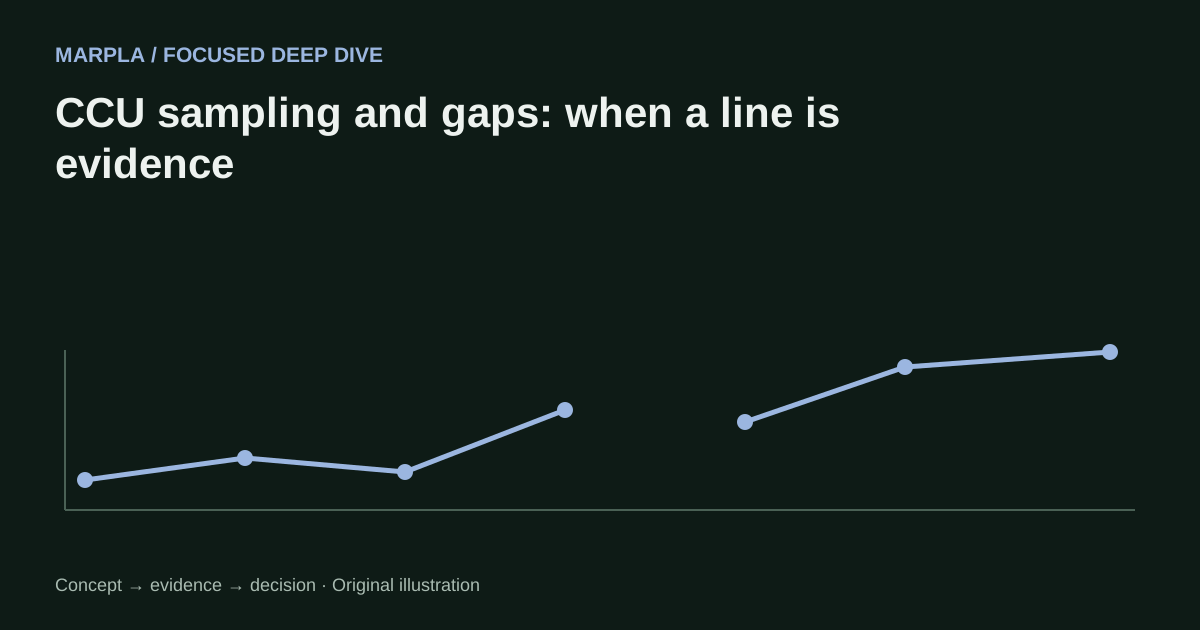 CCU sampling and gaps: when a line is evidence
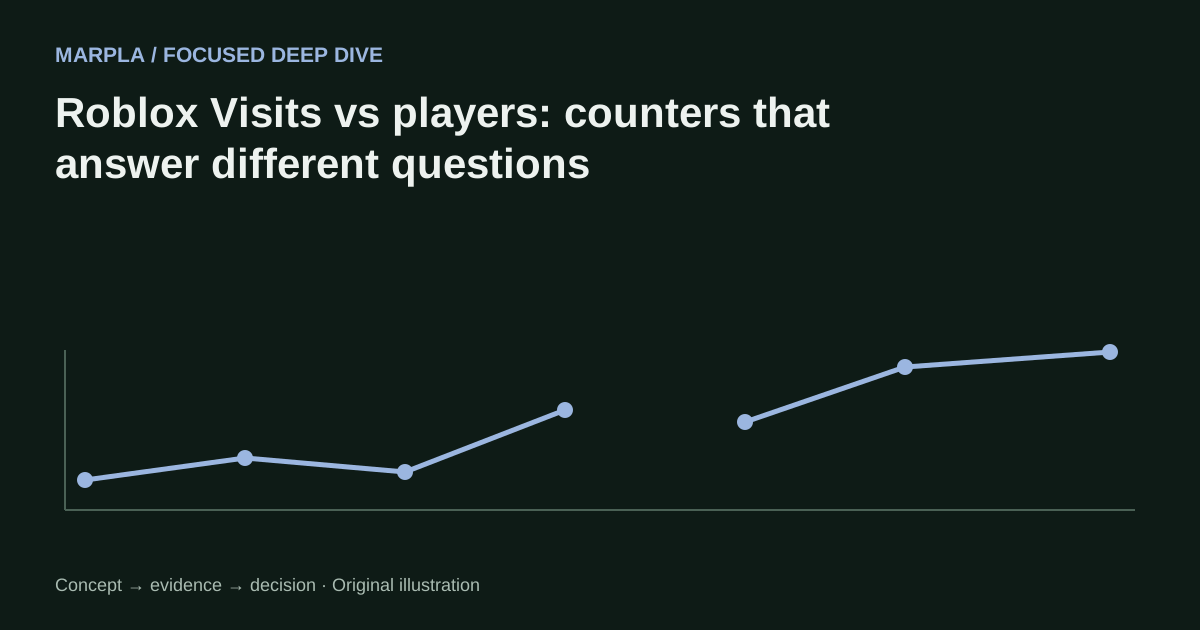 Roblox Visits vs players: counters that answer different questions
 Comparable peers and matched windows for Roblox analysis
 Owner analytics diligence: access, evidence, and scope
 Before-and-after update analysis: baselines and confounders
 From watchlist to decision: a Roblox research queue
 A public-data evidence ledger for Roblox research