Choose a promising game
The radar helps you shortlist games to watch and discuss with your team.
How to use it
- Open Prospects and set audience and stage filters.
- Sort games by signal or the metric you need.
- Read the signal explanation, then open an interesting game's card.
Advice and practical context
Signal as review queue
The radar finds unusual combinations of early momentum, growth, interest density, stability, and social signals. It cannot see team quality, code, obligations, or private economics. Sorting should set work order rather than automatically select a deal.
From signal to hypothesis
If a game rises over 24 hours, inspect seven days, Visits gain, and peak preservation, then play it and research the owner. Do not interpret a high signal as deal probability or a low score as proof of a bad game when coverage is limited.
Stage filters should represent measurable states such as early growth, spike, preservation, or cooling. If observation is too short, use an uncertain state rather than guessing. This prevents confident ranking of newly discovered candidates.
Technical detailsCalculations, permissions and behavior
Radar filters · 24h CCU
- 24h CCU / Visits
Maximum CCU in MARPLA's real snapshots over the past 24 hours / current cumulative Visits × 100%. For example, a peak of 1,000 with 100,000 Visits is 1%. This measures current interest density, not retention or conversion; Visits are not unique players.
Hover for the peak timestamp. It replaces the previous near-duplicate current CCU/Visits and peak/Visits columns.
- 24h CCU / game age
Maximum 24-hour CCU is divided by Universe age in days, with a denominator of 1 during day one. The unit is CCU per day of age: for the same peak, a newer game scores higher. This is a comparable age normalization of traction, not measured daily growth or proof of organic acquisition.
Roblox creation may predate public launch.
- Stages and filters
Stage is selected with dedicated buttons above the filters and does not occupy a table column. You can also limit age, genre, minimum CCU, maximum Visits, and 24h CCU / Visits. The table shows CCU / AGE before CCU / Visits; cells contain only values while units and formulas remain in the header tooltips.
The game-name width is preserved, with spacing between metrics. On narrower screens the table scrolls horizontally and the favorites star stays pinned to the right. Select a heading to sort.
- Signal 0–100 · model 3
Exact pre-rounding sum: 15 × min(1, √(24h peak / Visits, in %)) × min(1, Visits/10,000) × min(1, peak/100); plus 10 × min(1, log10(1 + peak/age in days) / log10(101)); min(15, max(0, 1h growth) × 0.25); min(20, max(0, 24h growth) × 0.4); min(10, max(0, 7d growth) × 0.1); min(10, log10(max(1, peak)) × 10/3); min(10, max(0, 95% lower rating bound − 50) × 0.2); when 0 < Visits < 1M, another 5 × min(1, peak/100); and 2.5 each for positive favorite and vote gains. For a spike the first 15-point block is zero and another 15 is subtracted; last-hour coverage below 65% subtracts 10. The result is rounded and clamped to 0–100.
It ranks review priority, not success or profit probability.
- Check before a deal
Check D1 of at least 15%, ideally 20%+, and PTR only against owner-shared data with dates, range, cohort size and paid-traffic separation. Public APIs do not expose these metrics for other games. Originality, viral niches and genre saturation require manual review; no automatic points are assigned.
D7 becomes useful when the cohort matures. Save findings in private notes.
Stages & signal quality
Radar stages update automatically from stored observations. Transitions require repeated confirmation over 15 minutes; sparse observations can freeze a stage. Few votes, sparse coverage and short spikes reduce confidence.
Collection targets five-minute cycles: new candidates and favorites have priority; other games rotate. Discovery lists, search and creator portfolios are not a complete Roblox registry, so detection of every new game cannot be guaranteed. Deal stages are changed manually and are separate from growth stages.
How the 0–100 Signal is calculated
MARPLA adds points from saved public observations, applies penalties, rounds the result and clamps it to 0–100. The table shows the maximum contribution of each block. Signal ranks games for manual review; it is not a success probability, valuation or profit forecast.
- Interest density · up to 15
24h peak CCU / Visits as a percentage, square-rooted to smooth extremes. The contribution is reduced below 10,000 Visits and below a peak of 100; it becomes zero when a short spike is detected.
- Age-normalized traction · up to 10
A logarithmic score for 24h peak CCU divided by Universe age in days. Day one uses a denominator of one.
- Growth · up to 45
One-hour growth contributes up to 15 points, 24-hour growth up to 20 and 7-day growth up to 10. Negative changes add no points.
- Player scale · up to 10
A logarithmic contribution from observed peak CCU: growth from a small to medium audience matters more than the same increase for an already large game.
- Rating · up to 10
Uses the lower bound of a 95% confidence interval for positive votes rather than the raw percentage. Points start above 50%.
- Early traction and confirmation · up to 10
A game with 0 < Visits < 1M receives up to 5 points for its peak; positive favorite and vote gains add 2.5 points each.
- Penalties · down to −25
A short spike subtracts 15 points. Last-hour coverage below 65% subtracts 10 because sparse snapshots reduce comparison reliability.
- Result
The sum is rounded to an integer and clamped from 0 to 100. The current interface uses model version 3.
Daily game archive sweep
MARPLA sweeps the entire saved archive from oldest observations to newest in bounded batches of the existing background collector. The target is to refresh each known game's core data within a day: name, Place and Universe IDs, creator, dates, genre, CCU, visits and favorites; votes and icons follow their own cadence. New IDs from charts, searches and public portfolios enter a durable queue even when they do not fit the current batch.
Unavailable games are retained and retried later. Prospects shows archive size, games checked today UTC and the queue. Roblox limits and outages can extend the sweep; these counters do not claim complete platform coverage.
Candidates are selected from stored signals independently of the market sample, up to 1000 with strong signals first. Name and ID search checks the full archive (up to 100 matches); known ordinary game links resolve from the database, while unknown links need Roblox. History and prospect scores use observed data only.
Stage reference
Useful articles: examples and decisions
The guide covers the steps in the service. These articles explain the metrics, examples, techniques and how to evaluate results.

How to find growing Roblox games: signals and a candidate card
Shortlist growing Roblox games using CCU trends, history, and data coverage. Includes a candidate card, repeat checks, and limits of public analytics.
Read article →
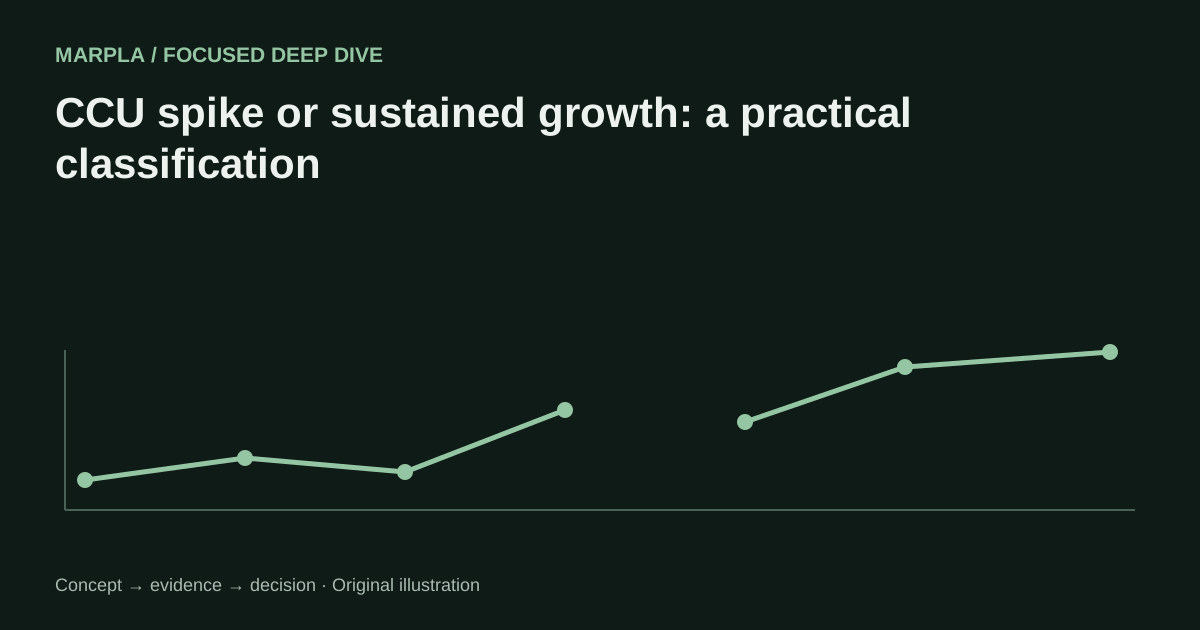
How to spot sustainable Roblox growth instead of a temporary spike
Use several time windows, supporting counters, and peak preservation to distinguish a rising baseline from a short burst.
Read article →