
Growth & updates
How to find growing Roblox games: signals and a candidate card
Find growing Roblox games through repeated observations rather than a single player-count spike. Record why a game qualifies, the comparison period, data coverage, and unknowns, then recheck the signal in a comparable window. MARPLA’s Prospects radar helps build that shortlist; its stages describe public movement, not a profit forecast.
Full guide
Signals are built from repeated observations
The radar uses recent CCU windows, 24-hour and seven-day movement when supported, Visits increments, favorites, votes, rating confidence, game age and observation coverage. A one-hour growth value compares average CCU in the latest window with an earlier baseline and requires separated real samples. Sparse history produces a dash or lower confidence instead of invented zero growth.
Stage changes require repeated evidence rather than one spike. The model also flags risks such as sparse coverage, few votes, a low conservative rating, a small Visits sample or an isolated CCU spike. The score is a bounded prioritization aid. Open the evidence panel to see why a candidate appears.
- Filter by stage to reduce the list.
- Sort by average 24-hour CCU, observed growth or another explicit signal.
- Open Signal evidence and check last-hour coverage and risk flags.
- Inspect the game card, creator portfolio, updates and CCU history.
- Save private contacts or notes only after signing in.
Discovery coverage is intentionally bounded
MARPLA does not have a complete registry of every newly published Roblox game. Discovery rotates through searches and Roblox charts, excludes sponsored search results, prioritizes new and watched candidates, and gives older records turns in bounded batches. A five-minute collection cycle does not mean every candidate is rediscovered or sampled every five minutes. Roblox cooldowns and incomplete responses are retained as coverage limitations.
A missing game is therefore not evidence that it has no momentum. Likewise, a newly found game may have too little history for a stage. Use the radar to create a shortlist, then validate with longer observation and direct product research.
Public momentum is only the first diligence layer
Public signals cannot reveal competitor revenue, retention, acquisition mix, payer behavior, ownership terms or code quality. Roblox's own creator guidance treats retention, engagement, monetization and acquisition as distinct KPI groups. Before a partnership or purchase, request authorized first-party reports and verify ownership and operating risks. Hypothetical example: a young simulator with rising CCU and improving votes deserves review; it does not justify an earnings estimate without owner data.
Turn a shortlist into a research queue
After the first filter, do not investigate every game with a visible signal at once. Build a short queue around the decision that must be made: study a genre, find a partner, monitor a competitor, or assess an advertising context. The same CCU movement has different weight for each decision, so rank position alone cannot set priority.
In a candidate card, separate observation from explanation. Growth in average CCU across stated windows with known coverage is an observation. “An update caused the growth” remains a hypothesis until the update date, a comparable period, and other traffic sources are checked. If a game disappears from observations, record the gap rather than treating it as a fall to zero.
Assign an owner to the next step and a recheck date. For product research, that might be a manual review of the first minutes and update notes; for a partnership or transaction, it means requesting authorized owner data. A public radar helps decide what to investigate next. It cannot replace verification of rights, finances, retention, or traffic origin.
| Decision | Public signal for selection | What remains unknown | Safe next step |
|---|---|---|---|
| Study a genre | Repeated movement with adequate coverage | Cause of movement and loop quality | Compare opening minutes and updates across similar games |
| Monitor a competitor | CCU, Visits, or rating movement | Paid traffic and retention | Observe again on a comparable day |
| Discuss partnership | Sustained public signals | Rights, team, and operating data | Request authorized first-party reports |
| Assess a transaction | Candidate for due diligence | Revenue, costs, and obligations | Move to legal and financial diligence |
Conditional example: review a signal in two windows
Conditional example, not a forecast: a game reaches the Accelerating stage after average CCU rises in the latest available window. The researcher does not write “the game is growing steadily.” They retain the sample date and time, both window lengths, coverage, game age, Visits movement, and any risk flags. They then choose a second comparable interval, such as the same weekday and a similar time of day.
The recheck has three useful outcomes. The signal confirms when movement appears again with adequate coverage. It weakens when the next period does not support the first observation, so the candidate stays in the queue without a strong conclusion. Data is insufficient when gaps or sparse history prevent comparison. None of these outcomes establishes revenue, organic ranking, or transaction value.
The next step follows the decision that would change with the answer. A team selecting research topics can record product and competitor patterns. A team considering money or project access needs authorized retention, acquisition mix, revenue, cost, and rights evidence. Do not fill missing fields with a CCU-based calculation; leave them unknown until they can be verified.
- Retain the original observation with coverage and risk flags, not only the stage.
- Choose a comparable recheck window; do not compare a weekend with a weekday without qualification.
- Record confirmation, weakening, or insufficient data.
- Update the research queue and name the decision that remains unsupported.
- Request private data only from the owner and for an agreed purpose.
Download the card and take the next step
Download the TXT card. Fill it in your own editor and leave unknown values blank.
Primary sources
Put this into practice in MARPLA
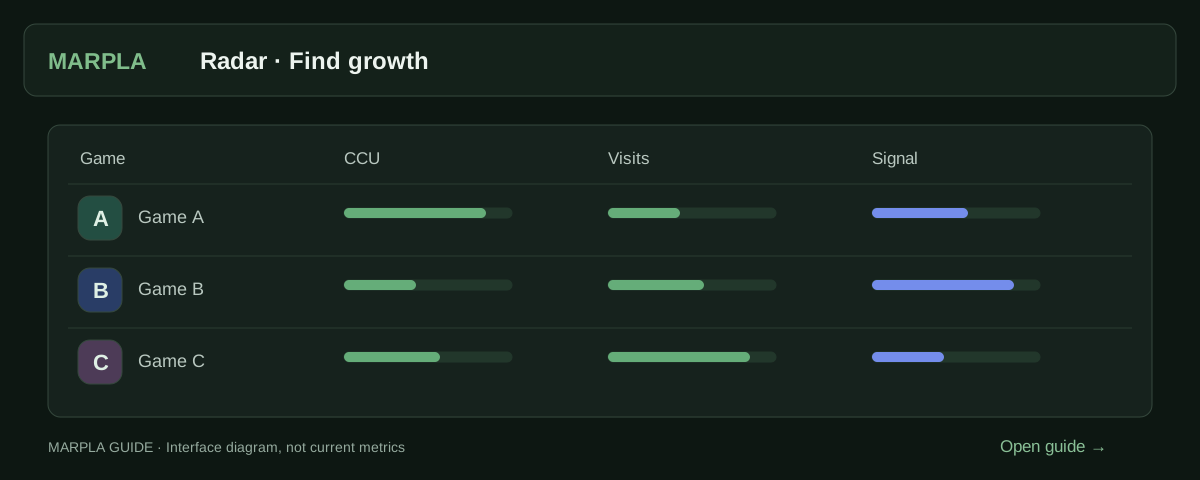
Set radar filters and inspect the evidence behind candidate signals. Confirm the movement with saved history, then retain promising games for monitoring.
- Choose a promising gameThe radar helps you shortlist games to watch and discuss with your team.Step-by-step guide →
- Follow game updatesMonitoring builds project history for later comparisons.Step-by-step guide →
Continue exploring
More on this topic →
Compare Roblox games on the same evidence
Place selected experiences on shared charts and separate real differences from timing and coverage artifacts.
Read article
Observed CCU history for Roblox games
Inspect saved concurrent-player samples with honest gaps, timestamps and range controls.
Read article
Public Roblox data vs owner analytics
Know what can be observed from the market, what requires permission, and where public estimates must stop.
Read article
Discussion0
Loading comments…