
Data & methodology
MARPLA growth Signal: how to use a 0–100 triage score
MARPLA’s growth Signal sorts public candidates for review. It is a bounded 0–100 score built from observed activity, age normalization, growth, scale, rating confidence, and supporting counter changes, with explicit penalties for spikes and sparse data. The score powers the [growth radar](/en/resources/find-growing-games); it is not an appraisal, investment rating, or forecast.
Focused deep dive
Inputs and safeguards
The current Model 3 uses the observed 24-hour CCU peak relative to cumulative Visits, CCU relative to Universe age, positive one-hour, 24-hour and seven-day growth, a logarithmic peak contribution, a conservative 95% lower rating bound, and small supporting contributions from positive favorite and vote changes. Low-Visits games can receive a bounded early-traction contribution. The formula caps every component so one spectacular percentage cannot consume the entire score.
A rapid rise followed by a collapse is labeled as a spike, removing the first ratio contribution and applying a penalty. Last-hour coverage below 65% also reduces the score. The candidate card exposes reasons, risks, coverage, observed peak, and stage. Stages require repeated evidence before transition, and gaps can freeze the prior stage instead of manufacturing a collapse.
Worked example: equal score, different risk
Game A rises from average 20 to 40 CCU in the supported hourly windows, has 80% coverage, positive 24-hour growth, 5,000 Visits, and 200 votes. Game B jumps from 200 to 500 at one point but falls to 180, has 40% coverage, and no reliable vote response. Both may briefly show eye-catching percentages. Model safeguards can reward A’s supported growth while penalizing B for sparse evidence and a spike.
Suppose A receives Signal 58 and B receives 42. This does not mean A has a 58% chance of success or is worth 38% more. It means A currently ranks higher under the documented public-evidence model. A direct play-test or owner diligence can still reverse the business decision.
Use the score to allocate attention
A useful workflow ends in a decision card, not a screenshot of the leaderboard.
- Filter candidates by the thesis, such as age, genre, and scale.
- Open the score reasons, coverage, and risk labels.
- Check the underlying timestamps and absolute bases.
- Play the game and collect a second independent signal.
- Save a next action and review date or pass with a reason.
Misuses that the score does not support
Do not compare scores from undocumented model versions as if the formula never changed. Do not hide a sparse-data penalty, copy the score into a valuation model, or call it predicted growth. Cumulative Visits, age, and public voting behavior vary by genre and lifecycle; peer context still matters.
The score sees only available public and derived fields. It does not know acquisition spend, retention cohorts, revenue, liabilities, source code, rights, team quality, or moderation risk beyond observed public signals. Use owner-data diligence before a consequential decision.
Decision record
Capture the model version, score, reasons, risks, coverage, and underlying timestamps. On the next review, explain whether the candidate moved because observations changed or because a newer formula changed the weights. The distinction protects the scouting history.
Primary sources
Put this into practice in MARPLA
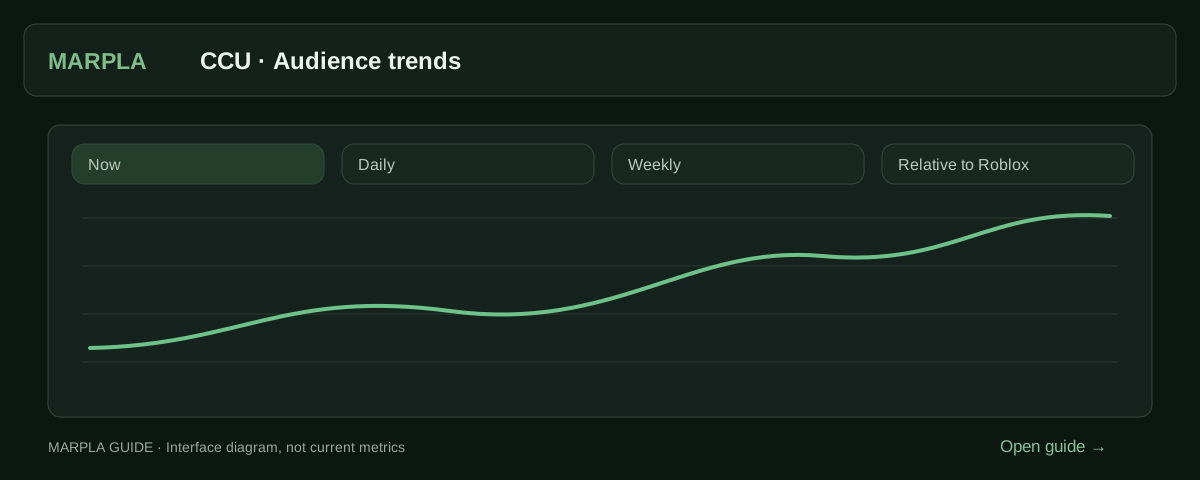
Open a game card and compare CCU over matching periods. Check changes against Roblox-wide concurrency before interpreting a spike as sustained growth.
- Set up a chartThe range sets how much time to show; the interval sets how points are grouped.Step-by-step guide →
- Understand game growthCompare changes in a game's audience with changes in Roblox's overall player count.Step-by-step guide →
Where this deep dive applies
Continue exploring
More on this topic →
MARPLA public-data methodology and privacy boundaries
Understand sources, sampling, derived metrics, access controls and the limits of public Roblox research.
Read article
How to find growing Roblox games: signals and a candidate card
Shortlist growing Roblox games using CCU trends, history, and data coverage. Includes a candidate card, repeat checks, and limits of public analytics.
Read article
How to spot sustainable Roblox growth instead of a temporary spike
Use several time windows, supporting counters, and peak preservation to distinguish a rising baseline from a short burst.
Read article
Discussion0
Loading comments…