
Launch & promotion
Roblox ad creatives: a testing plan and results review
Compare Roblox ad creatives through the full funnel: impressions, clicks, plays, and acquisition cost. Record the hypothesis and matching conditions before launch, then check delivery, campaign changes, and reporting maturity. A high CTR without confirmed plays does not tell you which variant deserves the next test.
Full guide
Separate Sponsored Ads from organic Home first
Roblox supports up to ten images per campaign and describes even distribution across players. Individual images can be enabled or disabled. This differs from the separate-campaign organization used in MARPLA, discussed below.
Organic Home thumbnail testing is a separate surface. Do not transfer its winner or metric into Sponsored Ads without a new test. On September 10, 2026, the qPTR-to-PTR transition could still appear unevenly across dashboards, so save the live tooltip's name and window with the export date.
Write the test card before buying traffic
The following is an editorial protocol, not a Roblox rule. Write one hypothesis: “a frame with a clear action will bring more suitable new players than a character portrait.” Freeze the campaign objective, audience, advanced targeting, dates, budget type, destination place, and game version. Creatives should differ by one explainable idea: action versus character, reward versus threat, solo versus co-play. Tiny color variations rarely give a producer an actionable answer.
Assign every file a stable code and store its source image, promise, and screenshot of the real gameplay moment. Before launch, verify that the promise becomes visible in the opening minutes. If the image advertises a mechanic the game does not deliver, more clicks only accelerate disappointment. Roblox separately says metadata should match the content, while misleading or non-unique presentation can limit exposure.
- State the decision the test will support: keep a concept, rewrite the promise, or stop acquisition.
- Choose one creative difference and keep all controllable campaign settings constant.
- Check 16:9 framing, small-screen legibility, gameplay fidelity, and moderation constraints.
- Code each image and log every enable, disable, and game-version change.
- Set a spend ceiling and review date without treating an invented CTR as a universal threshold.
Do not confound creative, audience, and bidding
Objective and audience change optimization and traffic composition. An image served to New Players cannot be compared fairly with another served to Lapsed Players. Hold objective, audience, advanced targeting, and destination constant for a creative test.
Some settings become fixed after publication while creatives and budget amount remain editable. If the question concerns audiences, run and label a campaign-level audience test. Mark the Learning period and avoid reacting to an early fluctuation without a technical fault or spend risk.
| Change | Hold constant | Decision you can make |
|---|---|---|
| Creative only | Objective, audience, targeting, dates, landing | Which promise moves players through the ad funnel better |
| Audience only | Creative, objective, period, budget logic | Which segment produces more useful traffic |
| Onboarding only | Traffic source and creative, or in-game randomization | Whether post-join behavior changed |
| Several factors | Nothing is isolated | A new observation, not a cause |
Read a funnel and calculate economics by source
Read the path in order: impressions→clicks→plays→cost→player quality. CTR diagnoses attention, but a lower-click creative can still generate more plays. Calculate cost per first-loop completion or retained player only when reliable variant-level attribution exists; standard Ads Manager reporting does not always provide that link automatically.
Reconcile ads with the Sponsored Ads source in Acquisition, not whole-game D1. Source-level D7, 7D playtime, and 30D measures mature at different times, and Ads Manager plays and earnings can lag. Mark early reporting preliminary and never compare an immature cohort with a mature one.
Decision card for interruptions and changes
Keep using the test card after launch by adding an event log rather than only final metrics. A game-version release, creative pause, moderation delay, budget edit, or reporting outage can create a new analytical interval. Comparing the full campaign across such an event answers a broad campaign question; it does not isolate the creative's contribution.
For every event, retain its exact time, time zone, affected variants, and reason. Then split the export into comparable intervals. If variant B paused or started serving later, a whole-period average cannot correct for that difference. Mark the comparison incomplete, retain it as an observation, and rerun the test in a fresh window with a matching start instead.
Also record the level at which each metric is visible. Ads Manager reports ad delivery, while Acquisition can report the Sponsored Ads source; neither is automatically a creative variant. Link later player behavior to an individual image only when variant-level attribution is actually configured. Without it, the card should say “check in the next iteration,” not assign D7 or earnings to an image.
| Event | Risk to the conclusion | Card entry | Next step |
|---|---|---|---|
| Game update during delivery | Landing or first loop changed | Release time and version | Do not combine before and after intervals; retest |
| Variant stopped early | Variants have unequal duration and delivery | Enable and disable times | Do not rank it against finalists as if concurrent |
| Reporting window still maturing | Cohort and earnings may be incomplete | Export date and window maturity | Schedule a recheck |
| New test with a different audience or objective | Traffic composition changes too | Old and new setting | Start a separate test cycle |
Worked example: more clicks, fewer plays
Conditional example, not a Roblox benchmark: two images ran in comparable windows with the same objective, audience, and landing destination. Variant A received more clicks, while B received fewer clicks but more confirmed plays. That does not make B a winner yet. First check actual impressions, serving dates, moderation, and the game version for differences.
For a game-start objective, compare cost per confirmed play using the same metric definition and currency: spend / plays. More total plays alongside higher spend does not by itself mean a better result. If B also has a lower cost per play, its promise becomes a hypothesis for the next test. Strong CTR for A with weak click-to-play progression calls for checking the promise, game page, and technical errors; these metrics alone do not identify the cause.
Do not use whole-game D1 to settle the conflict. It includes organic and other paid sources, and an early cohort may not be mature. Record the conclusion at its evidence level: “B generated more confirmed plays in this comparable interval” or “evidence is insufficient.” That wording lets the next team continue the test without turning a temporary observation into a rule.
- Match dates, objective, audience, landing, actual delivery, and the change log.
- Separate variant-level ad metrics from source-level game measures.
- Match the conclusion to the preselected goal, not the most visible green number.
- Choose one action: rerun without interruption, clarify the promise, inspect onboarding, or stop spend.
- Archive the export, decision card, and a recheck date for the mature cohort.
Do not promise that ad spend automatically lifts organic reach
On September 10, 2026, Discovery separated retrieval and ranking: other sources can accelerate consideration, while Recommended For You ranking evaluates organic users from that surface. Ads buy audience access, not guaranteed Home distribution.
DevForum is useful for questions, not platform truth. On August 29, 2026, the developer of GET OUT posted an ads-on/ads-off observation and reported sharply different paid-user behavior; Roblox staff accepted the bug report for investigation. This is one non-randomized case, not proof of a universal mechanism. It reinforces one operational practice: preserve source breakdowns and never evaluate a creative only through a whole-game aggregate.
Mistakes and FAQ
Common mistakes include changing image and targeting together, choosing a winner during Learning, mixing paid and organic tests, treating a click as a player, reading immature revenue as final, and failing to log a game update. A 2023 DevForum author reported spending heavily before testing a thumbnail and improving CTR after replacing it. This illustrates the cost of skipping a test; it is not an expected result.
FAQ 1: how many creatives? Ads Manager permits up to ten; the practical number depends on whether the budget can give each one useful evidence. FAQ 2: what is a good CTR? There is no universal threshold. Compare the same surface, period, and audience, then inspect plays and cohort quality. FAQ 3: can creatives change mid-campaign? Yes. Roblox lets you enable and disable them, but log every change because it starts a new analytical interval.
Apply this to MARPLA creative groups
The MARPLA One setup, multiple creatives form creates a separate campaign for each image. This differs from several images inside one Roblox campaign. Equal budgets do not guarantee equal impressions or audience composition. Compare actual delivery, periods and settings, and retain the limitations of your conclusion.
A practical technique: include a strong earlier creative as a control beside new ideas in the next test. Its previous result helps select a candidate but does not replace retesting under current demand. Do not compare variants stopped earlier with finalists as though they ran together throughout the period.
MARPLA Signal is an internal comparative score, not a Roblox recommendation metric or probability of success. Use it for initial selection, then inspect the underlying measures. A saved group-stop result preserves the finalists; a new test still needs fresh observations.
One-cycle action plan
- Capture baseline game metrics by source and let existing cohorts mature.
- Write one hypothesis and produce distinct, truthful 16:9 concepts.
- Create one campaign with fixed objective, audience, targeting, dates, and landing.
- Test launch data or the destination link, then allow for moderation.
- After Learning and reporting delay, compare impressions→clicks→plays→first loop.
- Later add mature D7/7D and 30D Acquisition measures for Sponsored Ads.
- Choose an action: scale, rewrite the promise, repair onboarding, or stop spending.
- Archive the test card, raw exports, limitations, and documentation check date.
Download the card and take the next step
Download the TXT card. Fill it in your own editor and leave unknown values blank.
Before the next advertising launch
Review objectives, audience, loss limits and stopping criteria in the smart Roblox advertising guide. It separates paid cohorts from organic Home and shows the MARPLA tools used to make the decision.
Primary sources
- Roblox Creator Hub — Ads Manager, checked September 10, 2026
- Roblox Creator Hub — current Discovery, checked September 10, 2026
- Roblox Creator Hub — source-level Acquisition
- Roblox staff — qPTR/PTR transition and dashboard mismatch
- DevForum — GET OUT developer observation, August 29, 2026
- DevForum — Escape The Clown's Circus creator experience, 2023
Put this into practice in MARPLA
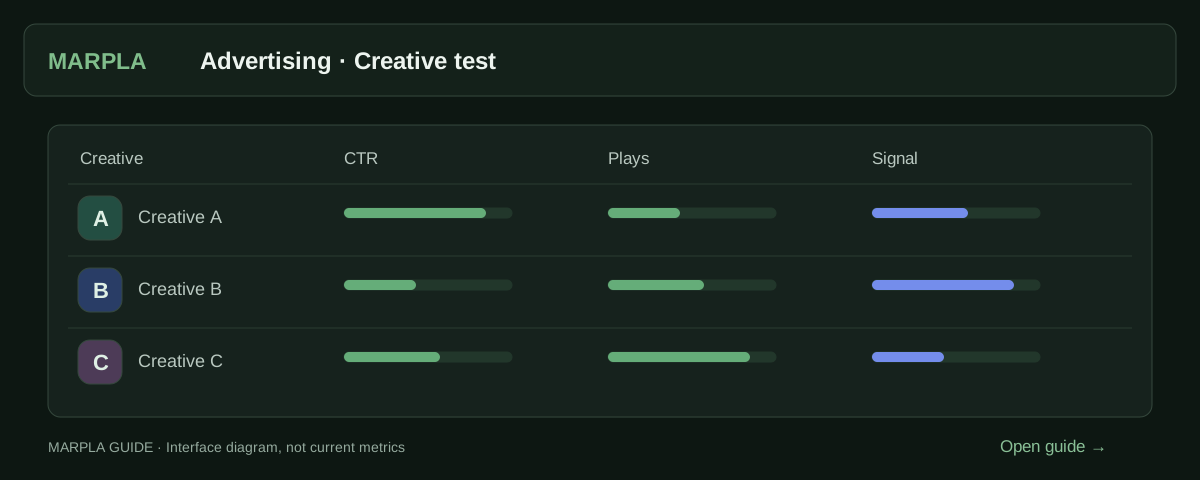
Create a grouped creative test in Advertising. Compare CTR alongside plays, spend and playtime: a high CTR alone does not establish acquisition quality.
- Work with campaigns and groupsUse the list to find campaigns, open tests and adjust advertising settings.Step-by-step guide →
- Compare advertising resultsReports help you see which campaigns bring players and at what cost.Step-by-step guide →
- Understand ad comparisonsCompare campaigns within one MARPLA group, and creatives within one campaign.Step-by-step guide →
Continue exploring
More on this topic →
How to improve a Roblox game's first session and retention
Move from observed playtests and an onboarding funnel to mature D1/D7 cohorts and testable changes.
Read article
A Roblox game launch and update plan: soft launch through review
A practical release checklist, source-level measurement, update operations, and community feedback loop.
Read article
Public Roblox data vs owner analytics
Know what can be observed from the market, what requires permission, and where public estimates must stop.
Read article
Discussion0
Loading comments…