
Growth & updates
Roblox Home recommendations: get discovered and sustain growth
Aim for suitable players who understand the game and return, rather than a single traffic spike. Work through three practical checks: the game is eligible for recommendations; its first users provide useful evidence; newly reached audiences still have a strong experience. There is no switch that turns on Home or a guaranteed concurrency threshold.
Full guide
Home is not one traffic source
Roblox Home contains Recommended for You (RFY), Continue, friends, ads and other surfaces. This guide focuses on organic RFY. Do not attribute every visit from Home to that system or call a paid impression organic. First identify acquisition source, then inspect the specific Home signals.
Start in Creator Hub → Analytics → Acquisition → Home Recommendations. Compare the timing of impression changes with signals and player composition. The official Discovery documentation separates candidate retrieval from ranking; these are not guaranteed successive growth tiers.
How a game becomes a candidate and earns impressions
| Stage | What is known | Creator action |
|---|---|---|
| Retrieval: candidate selection | The system considers games a particular user might enjoy. Evidence from multiple channels can help a game be considered. | Attract relevant initial players and measure their experience. |
| Ranking: personalized ordering | Organic RFY distribution relies on behavior from users organically acquired through RFY. | Improve those users’ first experience and repeat play. |
| Explore → expand | The system explores new audiences and may extend distribution when responses are strong. | Expect audience composition to change rather than demanding a constant average. |
Ads, search, friends, external communities and other channels can help surface a game as a candidate. They do not buy a durable position. Even a small genuine audience can provide evidence; Roblox does not publish a universal entry requirement for CCU, ad spend or D1.
A test after an update is a possible scenario, not a promise. Reach also depends on competing games, seasonality, Home visitors and Roblox changes. Stable metrics in your own game do not guarantee the same impression volume.
Which signals Roblox evaluates
Use the current signal list rather than an old formula from a video. The 2026 RFY description emphasizes PTR, early bounce, play days and time per user. These are several interacting signals, not a competition on D1 or average session alone. See the June Roblox update and staff replies for the current list.
| Signal | How to interpret it | What to inspect in the game |
|---|---|---|
| PTR | The share of RFY impressions followed by play. It is not advertising CTR. | A clear, accurate thumbnail promise. |
| First play bounce | Early departures, with separate under-60-second and 61–180-second windows. Higher is worse. | Loading, controls, the first goal and promise-to-game match. |
| Play days / playtime per user | Depth and repeat play across D1, D2–7 and D8–28. Playtime is capped at 60 minutes per user, per game, per day. | Progress, reasons to return and meaningful actions. |
| Intentional co-play days | Returning to play intentionally with friends. | Useful invitations and shared goals rather than pressure. |
| Qualified sessions, spend days, Robux per user | Additional engagement and value signals. | Core-loop quality and appropriate purchases. |
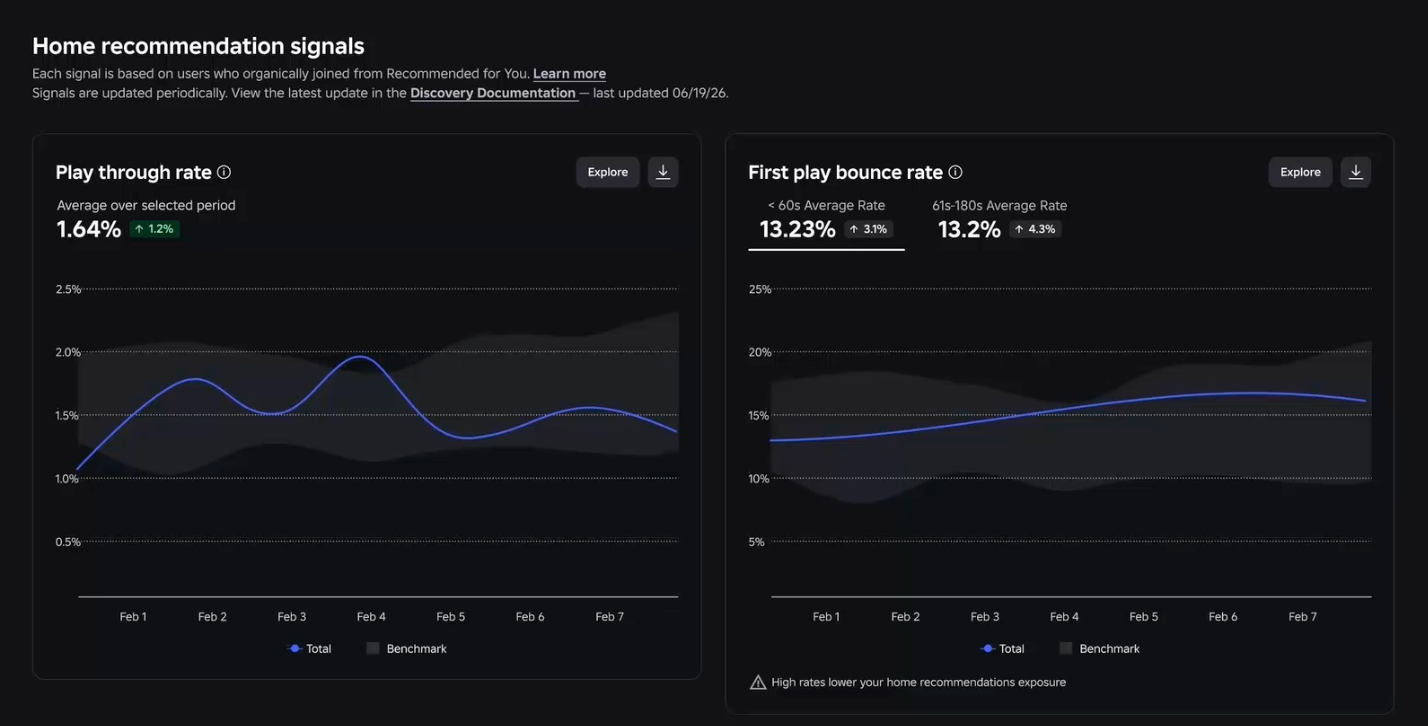
New games do not have to wait 28 days before ranking: early signals are available sooner, and longer windows add evidence as they mature. Do not compare yesterday’s immature cohort with a fully observed month. A dashboard benchmark is a reference point, not an algorithmic passing score.
What to prepare before a substantial test
- Check game availability, eligible audiences, moderation and reduced-visibility warnings. If Experience Beta is enabled, check its Home participation conditions separately.
- Test a first visit with a new account on a target phone: load, first action, understandable reward, saving and a return visit.
- Prepare accurate names and thumbnails. Do not lead with Robux promises or imitate another game’s name and artwork to appear equivalent.
- Instrument the first-step funnel and record the build. For multiplayer, test empty and underfilled servers.
- Bring a small relevant audience through genre communities, useful content or bounded advertising research. Decide in advance which outcome calls for a fix.
The practical fast path is to shorten the distance between the thumbnail promise and the first interesting action. Buying more traffic before fixing a broken entry usually just exposes the same problem faster. See first-session retention and smart advertising.
How new countries enter the audience—and what is unknown
A personalized recommendation matches a game to a person rather than giving creators a mandatory country ladder. Roblox describes audience exploration and expansion but does not publish a universal country sequence, country-test size or fixed D1 requirement for unlocking another region. A traffic spike alone cannot reveal the model’s internal decision.
A new country’s growing share can coincide with changes in language, device, age, time of day and acquisition source. Country is not language; language is not spending capacity; lower-end devices exist everywhere. Inspect the observed combination before attributing everything to nationality.
Organic Home countries cannot be configured like Sponsored Ads targeting. You can improve accessibility, translations, performance and audience fit, but an advertising country filter does not control organic RFY. Restricting a country simply to improve an average is a poor first diagnostic action.
Why averages can fall while the game grows
Consider a hypothetical example with disjoint new-player cohorts and equally mature D1. Initially country A supplied 1,000 players and 200 returned: D1 = 20%. Later A stayed unchanged, while country B added 1,000 players and 50 returns. Overall D1 = (200 + 50) / (1,000 + 1,000) = 12.5%. There are now 250 returns instead of 200, although the average rate fell.
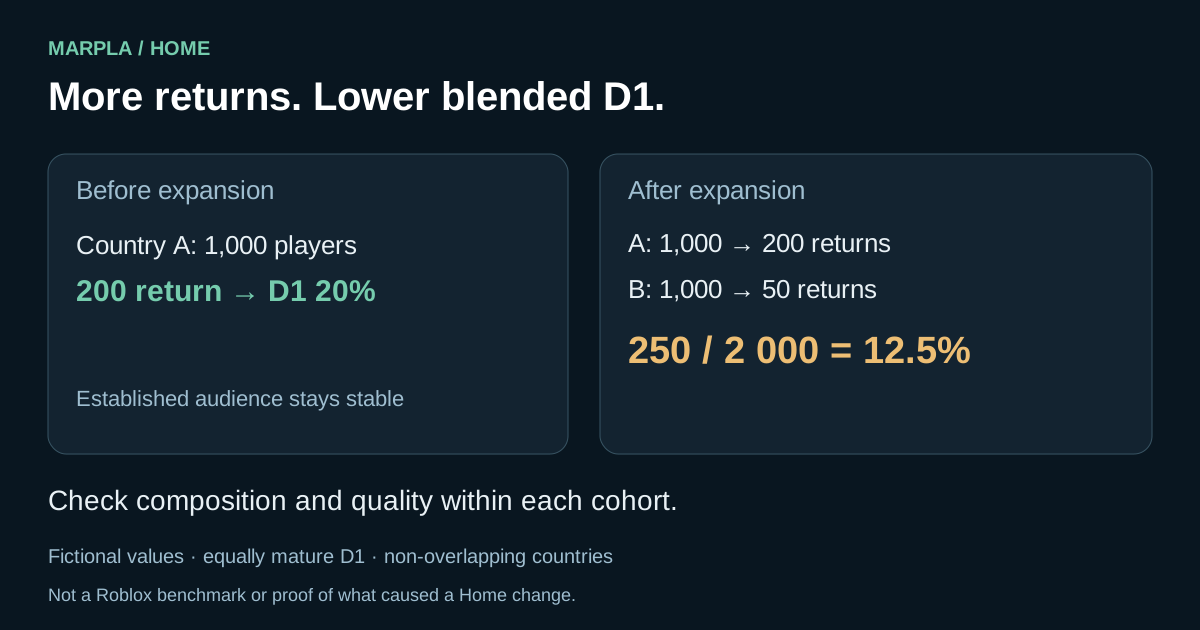
This is a composition change, not proof that A’s experience deteriorated. But if B arrived through organic RFY, its behavior belongs to the Home audience: you cannot declare a weak first experience harmless. In contrast, first-time ad-acquired users are excluded from the RFY ranking signals Roblox describes.
Real D1 requires the sizes of the corresponding cohorts. Do not weight D1 with daily DAU, average country percentages without weights or add overlapping sources. If denominators are unavailable, show the separate series and leave the exact composition contribution unknown.
What Roblox does as expansion changes metrics
Roblox explains that wider reach leads to a new metric baseline: not every new user is an immediate fan. Personalization continues looking for suitable players. This explains possible variation; it does not promise restoration of your old PTR or preservation of all traffic. See Discovery.
Exact country weights, normalization and redistribution rules are not public. Do not claim Roblox necessarily shields an established country from a new one or automatically discards all weak audiences. Inspect actual distribution and your own errors; collect a reproducible report for unexplained anomalies.
What to do when a new country has weaker metrics
| Observation | Check | Next action |
|---|---|---|
| Overall D1 falls while established countries stay stable | New-cohort shares, equal maturity and RFY source separately | Do not roll back the whole game on the average alone; investigate the new segment. |
| More first-minute exits in the new country | Phone performance, memory, loading, join errors and translation of the first goal | Repair the specific barrier and examine a new post-fix cohort. |
| Good entry but weak D2–7 | Progress clarity, saving, event timing and a reason to return | Improve the repeatable core loop rather than masking it with rewards alone. |
| Established audiences also deteriorate | Build, server load, prices, new thumbnails and latency | Investigate a product regression rather than only composition. |
| Stable metrics but fewer impressions | Seasonality, competition, visibility restrictions and Home changes | Do not accept an unsupported shadow-ban explanation; keep a dated record. |
| Sparse or incomplete data | Cohort sizes, reporting delays, UTC dates and gaps | Record the next review checkpoint; claim neither victory nor disaster. |
In practice: record the expansion date; compare complete matching weekdays; verify Home as the source; choose the country and an available joint device breakdown; locate the earliest changed funnel step; fix one cause; compare a new mature cohort. A single before/after chart cannot separate translation effects from an update and seasonality.
Localization and performance: repair the underlying cause
Start with the thumbnail promise, first goal, buttons, join errors and progress explanation. Have a fluent speaker check automatic translations on a real device for text length, wrapping, verbs and purchase names. Roblox supports automatic and manual localization; automatic translation does not establish that a particular scene makes sense.
- Inspect time to the first controllable action, not just FPS after loading.
- Check network conditions, heavy assets, memory, touch controls and the position of the key button.
- For social play, verify that newcomers can find an understandable team and start without a full server.
- Separate device and country effects: good independent percentages do not establish a good joint segment.
Thumbnails: serve the right segments
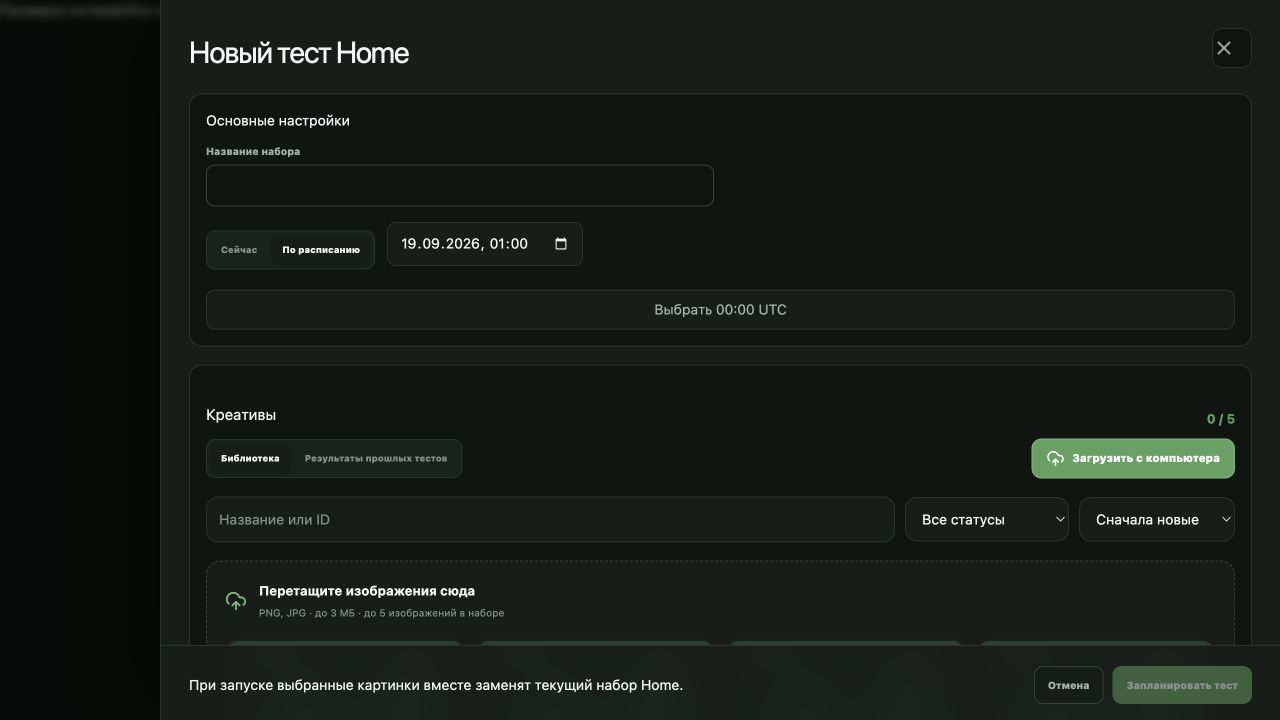
Home thumbnail personalization and game ranking are different mechanisms. With multiple active thumbnails, Roblox first gathers observations and then shifts impressions toward suitable variants for different groups while retaining some exploration. Do not treat the entire period as an equally randomized A/B test.
Keep multiple truthful alternatives rather than only the image with the highest overall rate. A new region may prefer something different. The current Roblox workflow activates 2–5 thumbnails; compare their promise with entry quality. QPTR remains a thumbnail-personalization metric, while the current RFY signal list separately emphasizes PTR and bounce.
In MARPLA, preserve set membership, dates and each image’s history. Do not automatically call winning segments countries: that depends on the detail Roblox actually returns. Rolling L7 values cannot be summed across days. See Roblox thumbnails.
How to investigate Home and countries in MARPLA
- Connect your own game with analytics permissions. Public CCU does not replace private Home signals. Connection instructions.
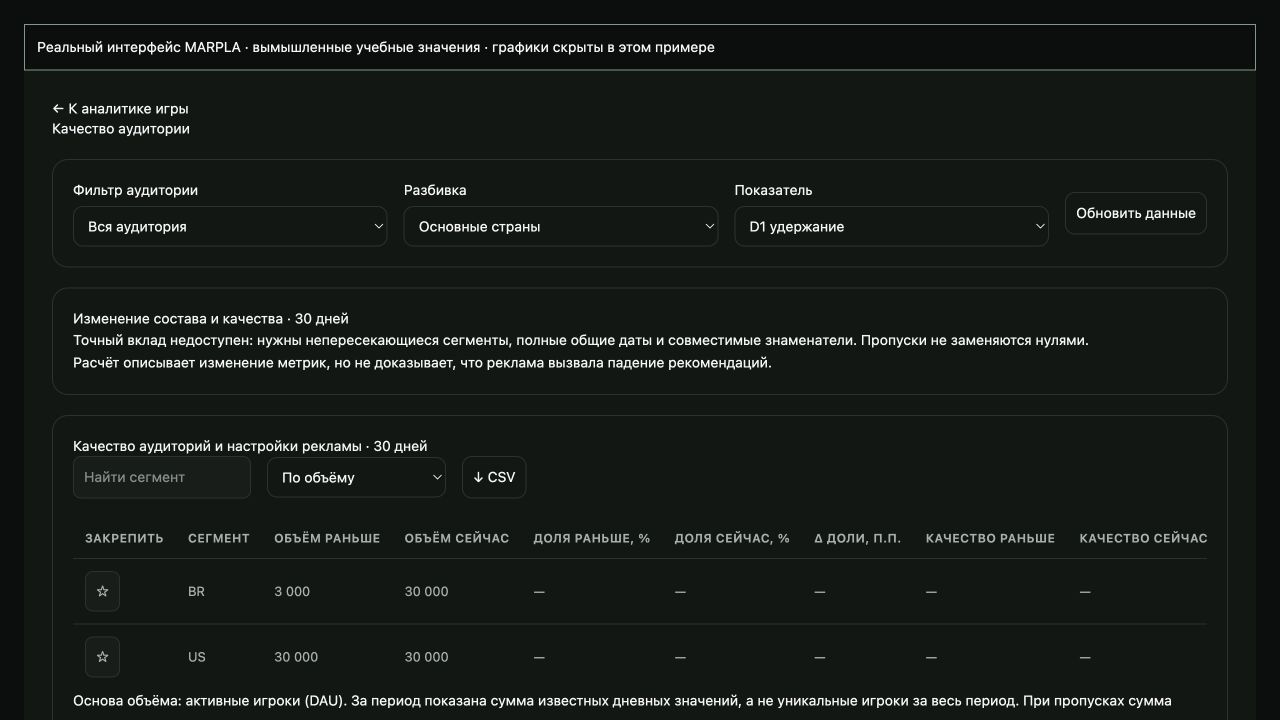
- In Audience quality, first inspect the full audience by clearing an unwanted saved filter. Choose countries and a metric, then separately inspect acquisition source and an available joint breakdown.
- Verify that Roblox actually supplied the combination. If source × country is unsupported or unavailable, do not manufacture it from independent totals.
- Enable the required country lines; they may all start disabled. Inspect the top ten and Other, UTC dates, gaps and retention maturity.
- The table compares the latest 30 complete days with the preceding 30; each chart has its own range. For a short event, inspect the chart rather than attributing a monthly result to one date.
- In Content → Home, inspect sets, membership, history and impressions. An image’s saved QPTR does not replace the full game-ranking signal set.
- Add a milestone or note with the expansion date, build, translation, creatives, hypothesis and next review window. Export CSV when a precise combined investigation is needed.
Use the Home and audience-expansion workflow, audience quality, Home set history and milestones. MARPLA’s internal scores help interpret observations; they do not expose Roblox’s model weights.
What to take from developers’ experience
| Case | Author’s observation | Useful lesson |
|---|---|---|
| RFY countries, September 2025 | The author received players from Brazil, Vietnam and Indonesia and compared weak purchases with previous advertising. | Inspect source and payer mix separately. This is an unverified self-report without a Roblox reply; suggested region restrictions do not establish a way to redirect RFY to the US. |
| Bamboo Tycoon, October 2025 | Retention and funnel completion improved while qPTR declined. The author suspected a mismatched audience. | Inspect composition rather than only averages and benchmark lines. The cause was not confirmed, and the case belongs to the older qPTR system. |
| Decline after a million impressions, June 2025 | The author reported losing roughly 85% of impressions after a peak. Roblox staff explained exploration and stabilization alongside platform demand and competition. | A peak is not a promised new baseline. A reply about one game does not establish a universal timeline or acceptable decline. |
| BODYCAM regional availability, 2026 | The game was unavailable in some countries despite Region: All; the author reported resolution after metadata changes. Roblox considered public-facing game material too. | For an abrupt country-specific stop, inspect availability and notices separately from retention. This is a regional-restriction case, not evidence of RFY expansion mechanics. |
The useful production discipline is to preserve context, check source and availability, and choose one next test. Someone else’s successful launch does not reveal Roblox’s hidden formula. Do not promote a creator’s opinion into a confirmed platform rule.
Techniques that shorten the path to a useful test
| Technique | Why it helps | How to check |
|---|---|---|
| One clear gameplay moment in the thumbnail and first visit | Reduces promise-to-experience mismatch | PTR together with bounce and first action. |
| A new-account test on a lower-end target device | Exposes barriers hidden from the team | Load time, errors and the funnel. |
| A small relevant starting audience | Provides initial evidence and feedback | Source, mature cohorts and a spending cap. |
| Several distinct truthful thumbnails | Gives personalization meaningful alternatives | Set results, exposure and play quality. |
| Localize and test FTUE before broad reach | Reduces unclear first-action risk | Language/country and device cohorts where available. |
| A substantial update with a reason to return | Supports repeat play rather than a one-off visit | Mature D2–7/D8–28 and play days. |
These improve the product and the team’s learning speed; they do not guarantee promotion. Fabricated activity, empty paid sessions, AFK time-padding, misleading rewards and endless thumbnail changes do not create durable value. Do not change gameplay, prices, targeting and the Home set at once: you will lose the ability to interpret the cause.
A decision card for the next spike
- Source and event: when did growth start, and is it genuinely organic RFY?
- Volume: impressions, players, new-cohort sizes and country shares.
- Quality: PTR, bounce, the first step and mature returns, split by available segments.
- Context: device, translation, update, creatives, servers and seasonality.
- Decision: observe, repair a specific issue, test a new hypothesis or report an anomaly.
- Next review: an exact date and required cohort maturity; define success before changing anything.
Download the Home review card. For a suspected Roblox issue, include the Universe ID, dates and time zone, source, screenshots showing filters and a change log. Timing alone does not establish an algorithmic bug.
Primary sources
- Roblox Creator Hub — Discovery
- Roblox Creator Hub — Acquisition
- Roblox Creator Hub — Thumbnail personalization
- Roblox Creator Hub — Localization
- Roblox Staff — RFY long-term retention update, June 2026
- Developer report — RFY country mix (2025)
- Developer report — Bamboo Tycoon (2025)
- Roblox Staff — Explore and stabilization (2025 case)
- Developer report and Roblox Staff — BODYCAM regional availability (2026)
- Roblox Staff — Home personalization updates, 2026
- Roblox Creator Hub — Metric-specific filters and breakdowns
Put this into practice in MARPLA
Separate organic Home from other sources, inspect countries and supported joint breakdowns, then relate audience changes to Home set history and record a hypothesis in a note.
- Investigate Home and new audiencesCheck source, countries and cohort maturity to separate audience-mix changes from a worse game experience.Step-by-step guide →
- Compare audience composition and qualityCompare a complete period with its predecessor and separate audience mix change from within-segment metric change.Step-by-step guide →
- Compare Home creatives and setsDistinguish set changes from statistics days.Step-by-step guide →
Where this deep dive applies
Continue exploring
More on this topic →
Roblox thumbnails: screenshots, staged scenes and practical testing
Choose Roblox thumbnails, structure the game-page gallery and test Home images: screenshots versus renders, PTR/qPTR, creative briefs and a practical workflow.
Read article
How to improve a Roblox game's first session and retention
Move from observed playtests and an onboarding funnel to mature D1/D7 cohorts and testable changes.
Read article
Roblox advertising: when to launch, how to target, and when to stop
A practical Roblox advertising guide: objectives, targeting, budgets, organic traffic, and pause decisions. Real interface screenshots and MARPLA workflows.
Read article
Discussion0
Loading comments…