
Data & methodology
Observed CCU history for Roblox games
A live CCU number answers only what Roblox reported now. MARPLA saves public observations so you can examine how concurrent players changed across hours, days and longer periods. The game history drawer provides range controls, timestamps and chart modes. For a one-hour view, the interface uses five-minute display buckets; longer views can aggregate observations into broader intervals. Every point still depends on an observation MARPLA actually received.
Full guide
Read the line as sampled activity
CCU means concurrent users: players online at the observation time. It is not DAU, which Roblox defines as unique players who joined at least once in a day. A CCU curve is valuable for launch peaks, daily cycles, update reactions and the duration of a surge. It cannot identify individual players or tell whether the same people returned tomorrow.
Hover or select points to inspect their exact saved time. Use shorter ranges for launch behavior and longer ranges for recurring daily patterns. A peak means the highest collected sample in the selected window, not necessarily the true maximum between samples.
- Open a public game's card and its CCU history.
- Choose a range that matches the event you are investigating.
- Check timestamp density before comparing peaks.
- Pair the curve with Visits changes and known update or event times.
Five-minute buckets are a target, not a completeness promise
MARPLA's public collector leases at most one bounded batch per five-minute UTC bucket. It prioritizes explicit targets, new discoveries and watched games, while part of the batch rotates through older stored games. Roblox rate limits, network failures, partial responses, deployment pauses and catalog size can all leave gaps. Therefore a '5 minutes' control describes the display interval and collector opportunity; it does not promise uninterrupted five-minute history for every game.
MARPLA preserves real zero CCU when Roblox reports zero, but does not fill a missing sample with zero. Long gaps remain discontinuities. Aggregated views summarize available observations and should be read together with coverage. Hypothetical example: if a launch has samples at 12:00, 12:10 and 12:20, the chart can show the observed shape, but it cannot claim what happened at 12:05 or that 12:10 was the exact maximum.
Do not convert CCU into private KPIs
CCU history cannot produce competitor retention, revenue, payer conversion or traffic attribution. Even the ratio of CCU to cumulative Visits is only an interest-density heuristic because its numerator is current activity and its denominator covers the game's lifetime. For an owned game, Roblox's authorized Analytics dashboard supplies DAU, retention, engagement, acquisition and monetization measures with their own definitions.
Primary sources
Put this into practice in MARPLA
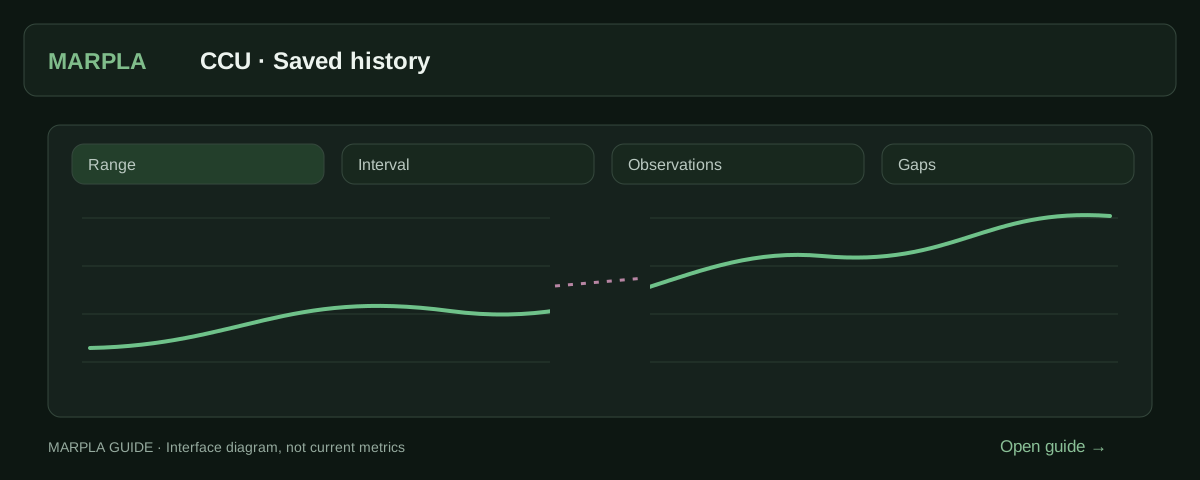
Open CCU history and set its range and interval. Check observation dates and gaps before concluding that the game declined or an update had an effect.
- Set up a chartThe range sets how much time to show; the interval sets how points are grouped.Step-by-step guide →
- Follow game updatesMonitoring builds project history for later comparisons.Step-by-step guide →
Continue exploring
More on this topic →
MARPLA public-data methodology and privacy boundaries
Understand sources, sampling, derived metrics, access controls and the limits of public Roblox research.
Read article
Roblox market analytics built from public observations
Track public Roblox experience signals in one catalog while keeping owner-only analytics separate.
Read article
Compare Roblox games on the same evidence
Place selected experiences on shared charts and separate real differences from timing and coverage artifacts.
Read article
Discussion0
Loading comments…