
Growth & updates
How to evaluate a Roblox update without claiming false causality
When a metric changes after an update, timing creates a useful clue but not proof. The same week may include a campaign, a weekend, a holiday, an influencer video, recommendation exploration, a competitor release, or a Roblox platform change. A rigorous review defines the expected mechanism before launch, records the release precisely, compares suitable windows and cohorts, and uses language that matches the design. Before-and-after analysis measures association; a valid randomized experiment is designed to measure causal impact.
Full guide
Write the measurement plan before shipping
State what changed, who receives it, and the behavior it should alter. Choose one primary metric tied to that mechanism and a small set of guardrails. An onboarding change might target new-user first-session retention and D1, while monitoring errors, crash rate, session time, and payer conversion. A shop layout might target payer conversion while guarding retention and player feedback. Do not select the best-looking metric after seeing results.
Record the exact release time, version, rollout percentage, eligible audience, places changed, campaign schedule, event calendar, and known incidents. Roblox’s public updated date is an observed metadata timestamp; it is not a complete release log and does not describe content magnitude. MARPLA’s public after-update windows should therefore be treated as temporal associations unless the team supplies a verified event record.
- Write the hypothesis and expected player behavior.
- Choose one primary metric, guardrails, segments, and evaluation window.
- Record the exact release, rollout, campaign, event, and incident timeline.
- Freeze definitions before reading the result.
- Check data quality and wait for delayed cohorts to mature.
- Compare the same weekdays and inspect acquisition mix and platform segments.
- Use an experiment when the decision requires a causal answer.
Build a defensible before-and-after view
Use equal pre- and post-periods, and compare the same weekdays when seasonality matters. For public data, inspect time-weighted mean CCU plus Visits, favorites, and vote rates over mature 1-day, 3-day, and 7-day windows. Show absolute levels and coverage beside percentage change. Avoid a window that starts at the lowest pre-release hour or ends at the highest post-release peak.
For owner data, inspect DAU and new users by acquisition source, new-user first-session retention, average session time, D1/D7 retention, payer conversion, ARPPU, and revenue as relevant to the change. Cohorts are assigned by first-play date, and recent D7 or D30 values remain empty until enough time passes. Comparing an incomplete cohort with a mature one creates a false result.
| Observation | Supported wording | Unsupported wording |
|---|---|---|
| CCU rose after release | CCU was higher in the measured post-release window | The update caused CCU growth |
| D1 rose for the release cohort | The cohort showed higher D1 | Every player preferred the update |
| A randomized variant wins | The experiment estimates a positive causal effect for its enrolled audience | The result applies to all future users |
| No detectable difference | The test did not detect the planned effect | The variants are identical |
Investigate alternative explanations
Acquisition mix is often the largest confounder. Players from Home recommendations, search, ads, friends, teleports, and external links can behave differently. Roblox also describes daily and seasonal variation, competition from other games, and changes in recommendation exposure. Break results down by source, new versus returning users, platform, country, and other supported dimensions when sample size permits.
Check technical health and instrumentation. A crash, slower loading, broken purchase receipt, or changed event name can move or erase a KPI. Roblox custom events are sent from published game servers, aggregate daily, and may take up to 24 hours to populate. Validate event counts and funnel continuity before interpreting product behavior. Keep a change log so overlapping releases do not get credited to the most visible feature.
Use experiments for causal decisions
Roblox Experiments can randomize in-game config variants or matchmaking configurations and are explicitly intended to measure causal impact. The documentation lists 14–60 days for in-game experiments, recommends attention to minimum detectable effect, and tracks retention, playtime, ARPU, ARPPU, payer conversion, and session time. Preselect the goal, control, variant, rollout, audience, duration, and stopping rule.
Illustrative example: after a tutorial release, seven-day public mean CCU is 25% higher and new-user D1 is higher. Report both as post-release associations. If a simultaneous 50/50 randomized experiment shows the tutorial variant improves D1 with a reliable decision while guardrails remain acceptable, then attribute the measured difference to the variant for the enrolled audience. Still state the period, audience, uncertainty, and limits on generalizing to future traffic.
When reach and audience composition change
Check source and cohort maturity before attributing lower averages to a worse game. The Home recommendations guide explains candidate selection, audience expansion, new countries and the corresponding MARPLA workflow.
Primary sources
Put this into practice in MARPLA
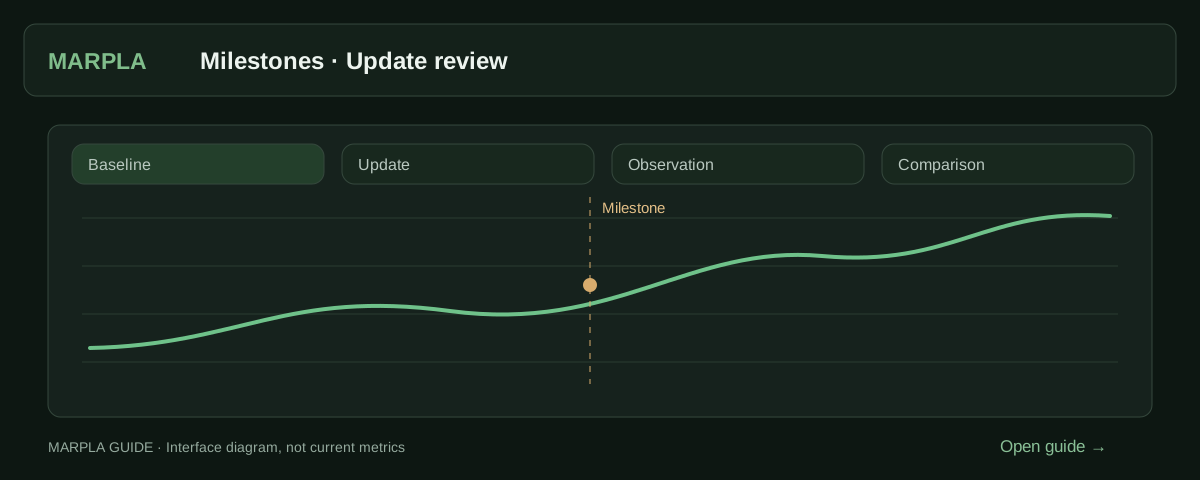
Record the update date and goal, then review new-cohort retention and audience trends. Compare matching days and account for advertising running at the same time.
- Add a milestone and track its resultA milestone marks a game change: an update, advertising, a new price or artwork.Step-by-step guide →
- Compare your game with benchmarksBenchmark scales show how your game performs alongside other projects.Step-by-step guide →
Continue exploring
More on this topic →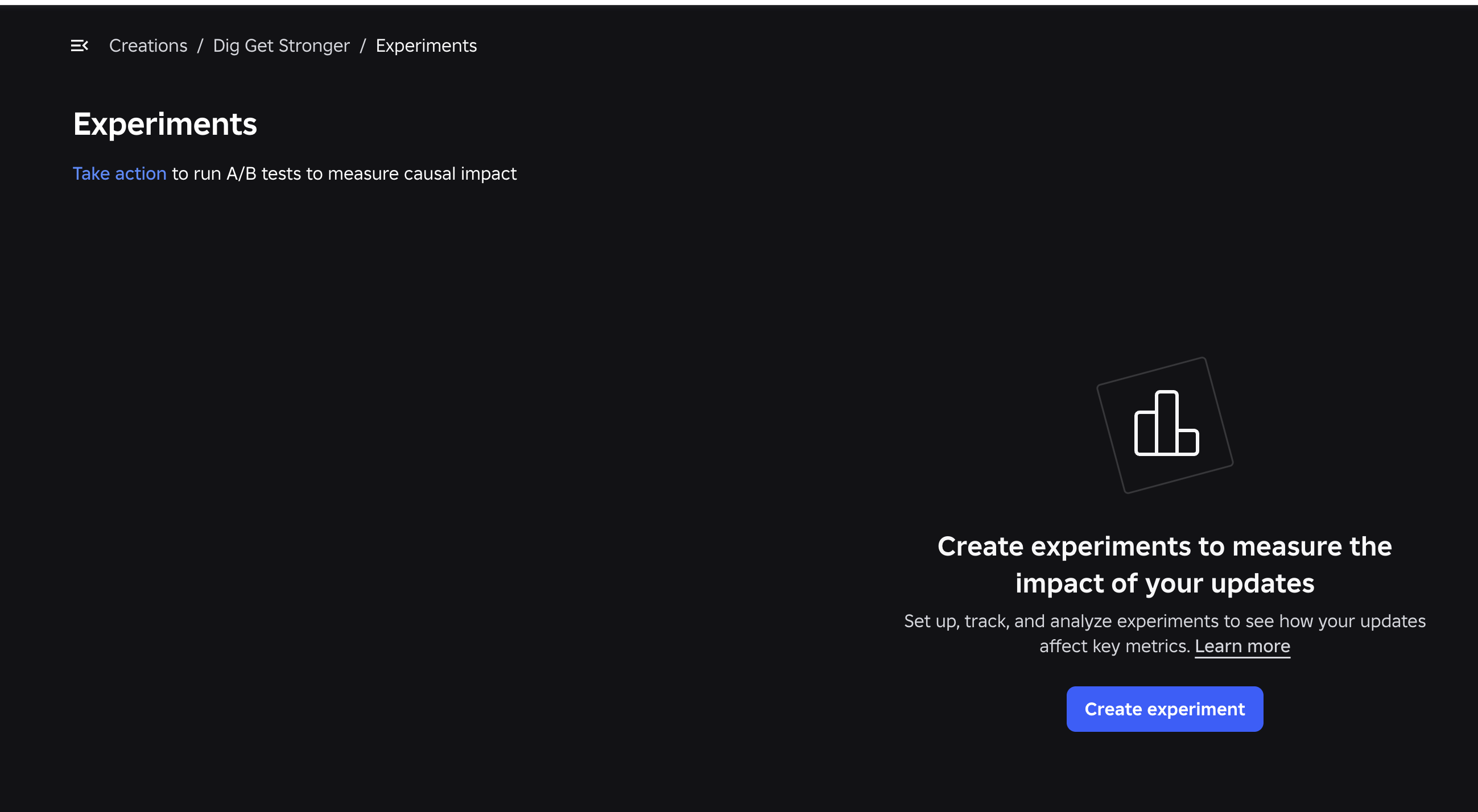
Roblox Experiments: how to run A/B tests and improve your game
Set up Roblox Experiments, select metrics and evaluate A/B tests: 8 game test ideas, creator case studies, interpretation pitfalls and an experiment template.
Read article
How to spot sustainable Roblox growth instead of a temporary spike
Use several time windows, supporting counters, and peak preservation to distinguish a rising baseline from a short burst.
Read article
Public Roblox data vs owner analytics
Know what can be observed from the market, what requires permission, and where public estimates must stop.
Read article
Discussion0
Loading comments…