
Comparing games
Compare Roblox games on the same evidence
A useful comparison starts with a precise question: which game has more current players, which one is sustaining momentum, or which update coincides with a lasting change? After you sign in, MARPLA lets you save public games to the observation list in Favorites and compare their recorded series over the same visible period. The public catalog remains available to guests, but this Favorites-based comparison workflow requires an account. Shared axes and matching timestamps make patterns easier to inspect, while each game's card retains its own source time and coverage. The feature supports research; it does not declare a universal winner.
Full guide
Build a defensible comparison
Choose games that are meaningfully comparable: similar genre, age, audience scale or product loop. A mature roleplay game and a launch-day simulator can both be interesting, but a direct growth ranking between them needs context. Select the metric and period, then toggle individual lines to inspect overlap, peaks and gaps.
Compare levels and changes separately. High CCU describes scale at the observed time. Percentage growth can make a small base look dramatic, while an absolute change shows how many concurrent players were added or lost. Visits, favorites and votes accumulate, so compare their increments across matched windows rather than raw totals alone.
- Sign in to MARPLA, then save two or more games to Favorites.
- Open Comparison and choose one question, metric and period.
- Check observation times and gaps before interpreting a divergence.
- Open each game card to review update dates, creator and supporting signals.
What a public comparison can and cannot prove
A simultaneous CCU rise after an update is a useful lead, not proof that the update caused growth. Promotions, time zones, weekends, Roblox recommendations and outages can affect the same window. Look for repeated evidence, a stable baseline and persistence after the first spike.
Roblox explains that discovery considers play-through, early bounce, play days, playtime, social play and spending signals for users arriving organically from Home recommendations. MARPLA's public comparison does not expose those private cohort measures for competitors. Do not translate a CCU advantage into a revenue or retention claim. If you own a compared game, use its authorized Roblox analytics separately to evaluate DAU, D1/D7 retention, session time, acquisition and monetization.
| Signal | Safe interpretation | Do not infer |
|---|---|---|
| CCU | Players online at observation time | Unique users or retention |
| Visits change | New visits recorded between snapshots | Exact sessions or source mix |
| Favorites/votes change | Public engagement counters increased | Revenue or payer conversion |
| Chart position | Observed placement in a collected Roblox list | Guaranteed future discovery traffic |
Primary sources
Put this into practice in MARPLA
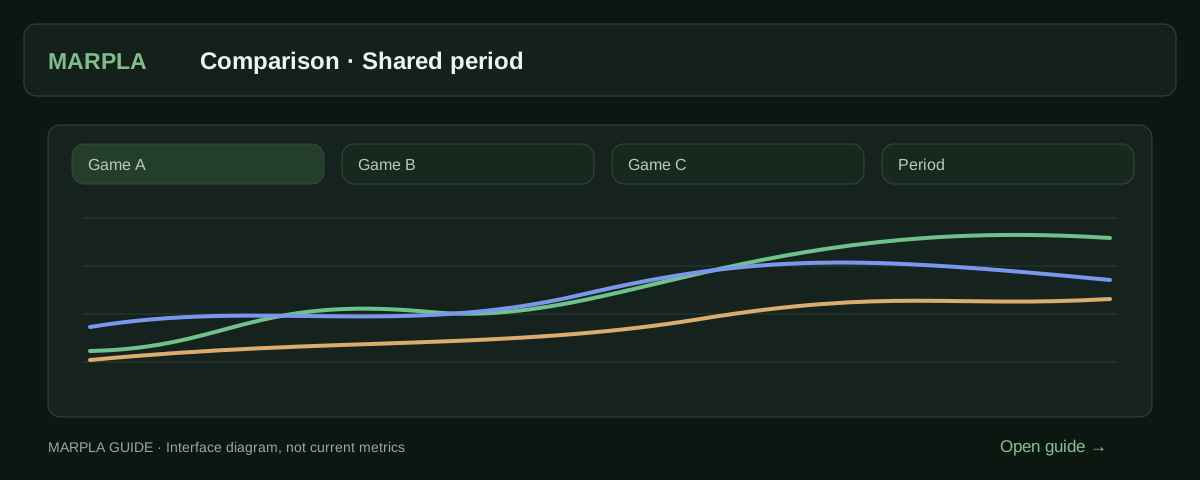
Select games and enable the relevant lines on a shared chart. A common metric and period help reveal differences without confusing scale with growth rate.
- Compare gamesCompare how several projects perform over the same period.Step-by-step guide →
- Set up a chartThe range sets how much time to show; the interval sets how points are grouped.Step-by-step guide →
Continue exploring
More on this topic →
Roblox market analytics built from public observations
Track public Roblox experience signals in one catalog while keeping owner-only analytics separate.
Read article
Observed CCU history for Roblox games
Inspect saved concurrent-player samples with honest gaps, timestamps and range controls.
Read article
How to find growing Roblox games: signals and a candidate card
Shortlist growing Roblox games using CCU trends, history, and data coverage. Includes a candidate card, repeat checks, and limits of public analytics.
Read article
Discussion0
Loading comments…