
Game analysis
Roblox market analytics built from public observations
MARPLA combines public experience metadata with its own saved observations so you can inspect a market without opening dozens of game pages. The catalog records values Roblox exposes publicly, including current concurrent users (CCU), cumulative visits, favorites, votes, creator identity, update dates and verified media. It then adds observation-based context such as recent CCU movement, chart appearances and an estimated session length. Public market data is useful for discovery and comparison; it is not a substitute for a creator's private analytics.
Full guide
A consistent public catalog
Search by game name, creator, Universe ID or a direct Roblox link. Sort the same catalog by the public signals that matter to your question, open a game card, and inspect public catalog data as a guest. Sign in to save games to the observation list and use those Favorites for comparison. MARPLA stores observations instead of treating one live number as history.
The current CCU value is Roblox's public playing count. Visits and favorites are cumulative counters. Vote totals support a conservative rating confidence calculation so a tiny vote sample does not look as reliable as a large one. MARPLA also records Roblox chart positions when a game appears in a collected chart.
Use timestamps as part of every result. A cumulative counter can rise between two samples even when the experience's CCU falls, because the measures answer different questions. Segment the review around known updates, weekdays and likely regional peaks, then save comparable games rather than treating the first sorted row as a conclusion. The catalog is most useful as a trail of leads: it tells you what changed publicly and where a closer product review is justified.
- Start with a broad sort such as CCU, recent movement or update date.
- Open candidates and check their observation time and history coverage.
- Sign in before saving comparable games to Favorites and opening their comparison.
Read the evidence at the right level
A collection cycle can be scheduled every five minutes, but that does not guarantee an exact five-minute observation for every game. The collector uses bounded batches, prioritizes watched and newly discovered games, rotates older records, and respects Roblox cooldowns and partial responses. Gaps stay gaps; a missing observation is not converted to zero.
Public CCU cannot reveal competitor revenue, retention, payer conversion, paid traffic share or unique daily users. MARPLA's public session estimate integrates observed CCU between snapshots and divides by the increase in Visits, then uses a weighted median and labels confidence. It remains an estimate, not Roblox's official Average Session Time KPI. For investment or operating decisions, request authorized first-party analytics from the owner.
Primary sources
Put this into practice in MARPLA
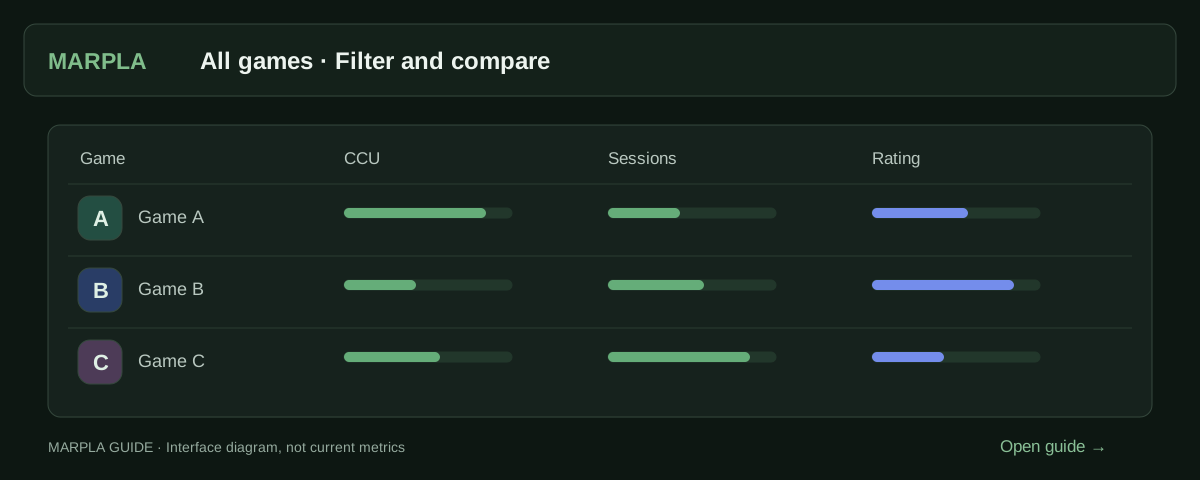
Arrange the list by your metric of interest, open game cards and compare selected games. Use this to find reference games and formulate a testable hypothesis.
- Find a game and arrange the listSearch finds a project; sorting helps you choose games by the metric that matters to you.Step-by-step guide →
- Compare gamesCompare how several projects perform over the same period.Step-by-step guide →
Continue exploring
More on this topic →
Compare Roblox games on the same evidence
Place selected experiences on shared charts and separate real differences from timing and coverage artifacts.
Read article
Observed CCU history for Roblox games
Inspect saved concurrent-player samples with honest gaps, timestamps and range controls.
Read article
MARPLA public-data methodology and privacy boundaries
Understand sources, sampling, derived metrics, access controls and the limits of public Roblox research.
Read article
Discussion0
Loading comments…