
Launch & promotion
A Roblox game launch and update plan: soft launch through review
A launch is not one publish hour. It is a controlled sequence: prepare measurement and rollback, let a limited audience break the build, repair critical issues, open chosen channels, and wait for the relevant data to mature. An update follows the same cycle at smaller scope. A sound plan names decision owners, traffic sources, events, stop conditions, and review times in advance. It does not promise an algorithmic pickup or treat the first CCU spike as proof of quality.
Full guide
Choose an access stage for the question
New games are private by default. For testers without edit permissions, choose Limited → Playtesters and meet publishing requirements. Experience Beta supports public testing without normal Recommended For You distribution. With Sponsored Ads, reports can nevertheless show users under that source: inspect attribution rather than assuming an obligatory zero.
Editorial protocol: private covers internal technical paths; Limited tests comprehension and defects with selected players; a time-bounded public test observes unfamiliar users; public launch scales an already observed product. “Soft launch” here means a small controlled release with bounded risk, not a special Roblox switch. Record the time and reason for every stage change.
Close readiness gaps before acquiring strangers
The release candidate should survive join, first loop, respawn, reconnect, persistence, purchase fulfillment, teleport, private server, and exit. Test claimed platforms, client-server boundaries, multiplayer, latency, empty servers, localization, and maturity settings. Prepare the prior stable version, a rollback owner, and incident communication.
Check packaging separately: metadata represents the real loop, assets cleared moderation, and prices match fulfillment. The funnel, build marker, errors, and performance checks must work. Give each external channel a share link or off-platform traffic collapses into Other.
- Assign a release owner, technical responder, community owner, and rollback decision maker.
- Freeze build/version, change list, known risks, and the prior stable version.
- Exercise critical paths in Studio and the published environment on target devices.
- Validate server events, View Events, errors, FPS, loading, and persistence.
- Prepare unique share links, creatives, and messages without unverified promises.
- Write stop conditions: data loss, join failure, widespread purchase non-fulfillment, or another critical harm.
Plan the release as a series of decisions
Choose audience size and stage length from risk and the question, not somebody else's number. A small group is effective for comprehension and defects but cannot establish D7 reliably. A large influx produces data faster but scales every unresolved blocker at a cost. A stage never advances automatically; the release owner decides from the recorded evidence and uncertainty.
| Stage | Main question | Inspect | Decision |
|---|---|---|---|
| Internal/Limited | Does the path work and make sense? | Errors, persistence, observation, funnel | Fix blocker or enter soft launch |
| Soft launch | What does a small unfamiliar audience do? | Source, first loop, session, mature early D1 | Repair, expand, or stop |
| Public launch | Can product and team carry growth? | Stability, acquisition mix, mature cohorts, support load | Continue channels, constrain, or roll back |
| Update | Does the release solve its stated problem? | Version, before/after, source, guardrails | Roll out, adjust, or revert |
| Postmortem | What do we now know? | Facts, hypotheses, missing evidence | One priority for the next cycle |
Separate sources and let metrics mature
Separate Home, Friends, Search, Sponsored, Teleport, and unique share links; Other does not identify an external channel. Compare sources on equally mature windows. A whole-game average can move solely because each source's share changed.
On September 10, 2026, Discovery emphasizes long-term retention. Do not use the older six-signal, seven-day qPTR model as the current specification; store the live tooltip, window, and export date.
On launch day, change little and log everything
Open access in the planned window, verify a real join through each channel, and record the exact time. During the opening hours, watch availability, errors, DataStore behavior, purchases, teleports, queues, matchmaking, and support reports. Apply technical stop conditions immediately. Do not interpret product measures before their window: a funnel can expose a blocker quickly, Ads reporting lags, D1 needs the next day, and D7 needs a week.
Without a critical fault, avoid a stream of emotional publishes every few minutes. Every build damages comparability and can restart servers or change the journey for new users. Maintain a log with time, build, channel, budget, message, config change, reason, and owner. For an urgent fix, state which cohorts received the broken build and which received the repaired one.
Use community as a sensor and an update as a promise
Prepare one path for bug reports, one for suggestions, and a short template: device, time, location, expected behavior, and actual behavior. Group repeated reports and connect them to errors and funnel evidence, but do not treat comment volume as audience share. Publish known critical issues and fix status where the project's players already follow updates.
Roblox Events & Updates can create events and notify opted-in players about releases. On the check date, an update announcement is limited to 60 characters and one every three days; the Events and Updates interface is still being combined. Name accessible new content instead of saying “bug fixes.” Review views, visit rate, and unfollow rate, then connect joins to version and source. Recheck these limits in the live form before sending.
Worked hypothetical co-op survival launch
The team first opens Limited access to unfamiliar testers. They can join and finish the first round, but a host departure breaks the party. After reconnect and persistence are repaired, a short public soft launch runs with Beta Mode: organic Home impressions are not used as a normal-launch criterion, and external groups receive distinct share links. The funnel reveals loss before role selection; observed tests find unreadable role descriptions on phones.
After the fix and D1 cohort maturity, the team opens normal public access and one Sponsored test. CCU rises on launch day, but the report separates Sponsored, Search, Friends, and Home. A week later, the paid D7 cohort remains separate from Friends rather than turning a blended percentage into “the launch result.” A new-map update receives its own build marker and announcement; usage, stability, and mature return behavior determine the next map, not the notification spike.
Cases, mistakes, and FAQ
In a 2019 article, developer fly_san described opening part of the District 45 map to the public. A useful idea is testing a limited but understandable slice of a product. This personal experience does not establish that every early release succeeds. Define the complete value a tester receives and the evidence needed before expanding your own release.
Mistakes include buying large traffic before checking the first loop, having no rollback owner, changing release, creative, and price together, expecting D7 tomorrow, treating Other as a known external channel, publishing a vague update, and mistaking a friendly beta group for the market. FAQ 1: when is soft launch ready? When critical paths are safe and instrumented. FAQ 2: must launch be large? No; size follows the question and acceptable risk. FAQ 3: when should we roll back? Immediately for predefined critical harm; investigate product uncertainty without a panic revert.
Operational launch or update plan
- Define the stage question, audience, access mode, and maximum acceptable risk.
- Assign release, rollback, metrics, and community owners.
- Test critical paths, platforms, persistence, purchases, and the prior stable version.
- Enable the funnel, build marker, error checks, and one unique share link per external channel.
- Run Limited or a small soft launch and repair demonstrated blockers.
- Open public access and channels according to the log while enforcing technical stop conditions.
- Review early measures quickly, but D1/D7/30D only when mature and separated by source.
- Publish a concrete message, collect feedback, and connect repeated reports with telemetry.
- Run a postmortem: facts, limits, decisions, one priority, and one owner for the next cycle.
When reach and audience composition change
Check source and cohort maturity before attributing lower averages to a worse game. The Home recommendations guide explains candidate selection, audience expansion, new countries and the corresponding MARPLA workflow.
Primary sources
- Roblox Creator Hub — publishing and access
- Roblox announcement — Experience Betas, published Dec 11, 2025, checked Sep 10, 2026
- Roblox Creator Hub — recommended strategies and playtest formats
- Roblox Creator Hub — Studio testing modes
- Roblox Creator Hub — Acquisition sources and windows
- Roblox Creator Hub — current Discovery, checked September 10, 2026
- Roblox staff — qPTR/PTR transition note
- Roblox Creator Hub — Experience events and updates, checked September 10, 2026
- DevForum — fly_san, District 45 (2019)
Put this into practice in MARPLA
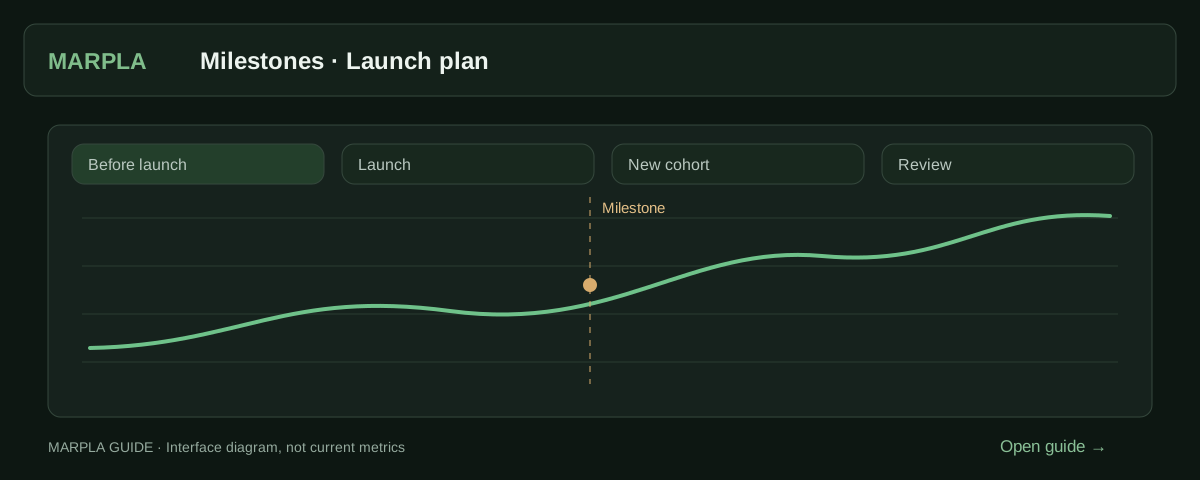
Mark a launch or update as a milestone, record your hypothesis and compare acquisition before and after. Check traffic sources so an advertising effect is not mistaken for an update effect.
- Add a milestone and track its resultA milestone marks a game change: an update, advertising, a new price or artwork.Step-by-step guide →
- Understand your audienceLearn how players find your game, where they live and which devices they use.Step-by-step guide →
Continue exploring
More on this topic →
How to improve a Roblox game's first session and retention
Move from observed playtests and an onboarding funnel to mature D1/D7 cohorts and testable changes.
Read article
Roblox ad creatives: a testing plan and results review
Test Roblox ad creatives with a hypothesis card, change log, and comparisons of CTR, plays, and spend. Includes a worked example and downloadable template.
Read article
Roblox Experiments: how to run A/B tests and improve your game
Set up Roblox Experiments, select metrics and evaluate A/B tests: 8 game test ideas, creator case studies, interpretation pitfalls and an experiment template.
Read article
Discussion0
Loading comments…