
Game analysis
How to analyze a Roblox game before investing time or money
A game can look large and still be declining, or look small because it has only just started to grow. A useful review therefore begins with a decision, not a score: are you deciding whether to play, build a competing game, join the team, buy a stake, or fund user acquisition? Each decision needs different evidence. Public data can narrow the field, but it cannot reveal retention, acquisition quality, costs, or revenue. Treat the first pass as a way to decide what to investigate next, not as a valuation or promise of success.
Full guide
Define the decision and evidence threshold
Write down the decision, deadline, maximum downside, and the claim that must be true. For a partnership, the claim might be that the game has a stable audience and a team able to ship. For an acquisition, it might be that engagement and revenue survive without a single traffic source. A public review can challenge those claims, but an owner must supply private analytics and commercial evidence before money changes hands.
Use three labels in your notes: observed fact, derived estimate, and hypothesis. Current CCU, cumulative Visits, public rating, favorites, owner, title, and reported update time are observations. A growth rate calculated from stored snapshots is derived. Statements such as “the update caused growth” or “players retain well” are hypotheses until stronger evidence appears. This simple separation prevents a persuasive story from becoming a false fact.
| Question | Useful evidence | What it cannot prove |
|---|---|---|
| Is there an audience now? | Fresh CCU snapshots across the day | Unique daily users or retention |
| Is activity growing? | Equal-window CCU means and Visits deltas | Why the change happened |
| Do players like it? | Rating with vote count, favorites, direct playtest | Long-term satisfaction |
| Is the business healthy? | Owner analytics, verified costs and revenue | Future profit |
Run the public-data pass
Confirm the exact Universe rather than trusting a copied title. Check owner, creation date, current metadata, and observation freshness. Then read the time series: current CCU is one point; the mean, range, and coverage over 24 hours and seven days show whether that point is typical. Visits are cumulative entries, including repeat visits, so compare their change over a window rather than treating the lifetime total as a current audience.
Look for agreement between independent signals. Sustained CCU growth accompanied by new Visits, favorites, and votes deserves more attention than a lone CCU spike. Check whether activity remains above its former baseline after 48 hours and after a week. If observation coverage is incomplete, label the result incomplete. Absence of a sample is missing evidence, not zero activity.
- Resolve the exact game URL or Universe ID and confirm the owner.
- Record when each metric was observed and whether the window has adequate coverage.
- Compare current CCU with 24-hour and 7-day means, not with a single convenient point.
- Calculate Visits, favorites, and vote changes only between valid boundary snapshots.
- Compare the game with peers of similar age, scale, and genre.
- Play the game on representative devices and record onboarding, core loop, performance, social play, and monetization friction.
- List the private evidence still needed and set a pass, investigate, or reject decision.
Ask for the evidence public data cannot supply
Roblox Creator Analytics gives authorized owners and group members metrics such as DAU, new users, session time, D1/D7/D30 retention, acquisition sources, payer conversion, ARPPU, and revenue. Request exports or a live, date-filtered walkthrough. Reconcile totals with the same time zone and period, and ask whether campaigns, events, outages, price changes, or major releases affected the window.
For a financial decision, also verify ownership, permissions, liabilities, contractor obligations, moderation history, infrastructure costs, and the terms behind any revenue claim. Analytics describes past behavior; it does not guarantee transferable users, future distribution, or profit. Roblox’s similar-game benchmarks are useful context, but the peer set can update and the benchmark itself does not drive recommendations.
Illustrative decision record
Illustrative example: a game has a higher seven-day CCU mean than the previous seven days, rising Visits, and a stable rating with a substantial vote base. This supports the statement “observed activity increased during the measured period.” It does not support “the latest update caused the increase” or “the game is profitable.” The next request should be acquisition by source, retention cohorts around the change, and verified revenue and costs. If the owner cannot provide them, price that uncertainty into the decision or stop.
Common mistakes are ranking by lifetime Visits, comparing a new game with a mature hit, treating a high rating from few votes as certainty, assuming an update timestamp describes the content shipped, and converting a public activity score into a purchase price. Keep a short audit trail with source, observation time, formula, limitation, and open question for every important claim.
Primary sources
Put this into practice in MARPLA
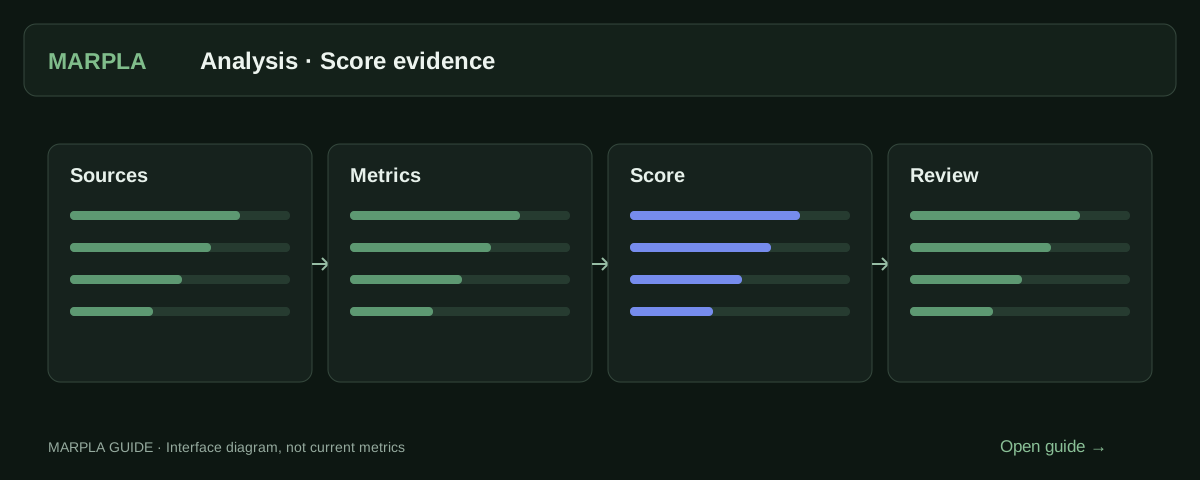
Select a game in Analysis and inspect its sources and score components. Use them to choose your next research question rather than treating the score as a verdict on success.
- Start analyzing a gamePublic analysis helps you explore a game's audience, activity and rating.Step-by-step guide →
- Understand scores and riskScores help you choose projects for a closer look.Step-by-step guide →
Continue exploring
More on this topic →
CCU, Visits, and growth: what the numbers actually say
Understand Roblox audience metrics without confusing a live snapshot, a lifetime counter, and a measured trend.
Read article
How to compare Roblox games fairly
Build a peer set, align time windows, normalize scale, and keep public comparisons within what the data supports.
Read article
Public Roblox data vs owner analytics
Know what can be observed from the market, what requires permission, and where public estimates must stop.
Read article
Discussion0
Loading comments…