Data & methodology
MARPLA public-data methodology and privacy boundaries
MARPLA separates two evidence classes. Public market research uses information Roblox exposes without a creator's private authorization and MARPLA's own timestamped observations. First-party analytics uses an authorized connection for a specific game and workspace. Keeping those classes separate prevents a public CCU pattern from being presented as private retention or revenue, and prevents one team's connected data from entering another team's view.
Full guide
Public collection and derived measures
The public catalog verifies game identities and reads public details such as playing count, Visits, favorites, votes, creator metadata and media from fixed Roblox origins. MARPLA stores observations with their timestamps, deduplicates snapshots and preserves gaps. A leased collector can attempt one bounded catalog batch per five-minute UTC bucket, with request ceilings, pacing, low concurrency and durable Roblox cooldowns. Priority and rotation mean actual per-game coverage varies.
Derived public measures disclose their construction. Growth compares supported observation windows. Rating confidence uses a Wilson lower bound so small samples are penalized. The session estimate approximates player-minutes from the area under the CCU curve and divides by added Visits; implausible or delayed-counter intervals are excluded and confidence depends on sample count and span. None is an official Roblox KPI.
Scouting and analysis scores are triage tools
Prospect stages require repeated samples and carry coverage and risk flags. The separate public Analysis model compares available metrics with cohorts by age, Visits and genre. Its configured groups cover growth, estimated engagement, CCU/Visits density, stability, niche, update effects and social signals. Missing groups are not replaced with zero; available weights can be renormalized, while low evidence produces a provisional result or low confidence.
A score is not a probability of success, valuation or causal estimate. It ranks what to inspect next under a declared formula version. Large changes still require checking dates, baselines, confounders and the underlying product.
Authorized analytics and access control
Roblox documents DAU, retention, engagement, acquisition and monetization as creator analytics. MARPLA requests these only for an authorized game through granular Open Cloud access such as universe.analytics:read. API keys and OAuth tokens stay server-side; the application scopes reads by workspace, game and user permission. Public pages do not receive private analytics, identities, deal notes or integration secrets.
The privacy policy states that MARPLA processes account, role, integration, game and diagnostic data needed to operate the service; it does not ask for Roblox passwords or sell personal data. Users can disconnect Roblox and revoke access. Sensitive application pages are marked noindex in route metadata.
Claims MARPLA deliberately avoids
Five-minute scheduling does not guarantee exact five-minute historical coverage. Missing samples are not zero. Public CCU is neither DAU nor retention. Cumulative Visits do not identify exact sessions. Public activity cannot reveal competitor revenue, payer conversion or paid traffic share. Correlation around an update does not prove causation. Roblox itself describes multiple recommendation signals, so no single public measure should be called the discovery algorithm.
No Google Analytics, Search Console verification, Bing verification or third-party visitor tracking integration was found in the reviewed application code. This is a repository finding, not proof about DNS, hosting dashboards or systems outside the checkout.
Primary sources
Put this into practice in MARPLA
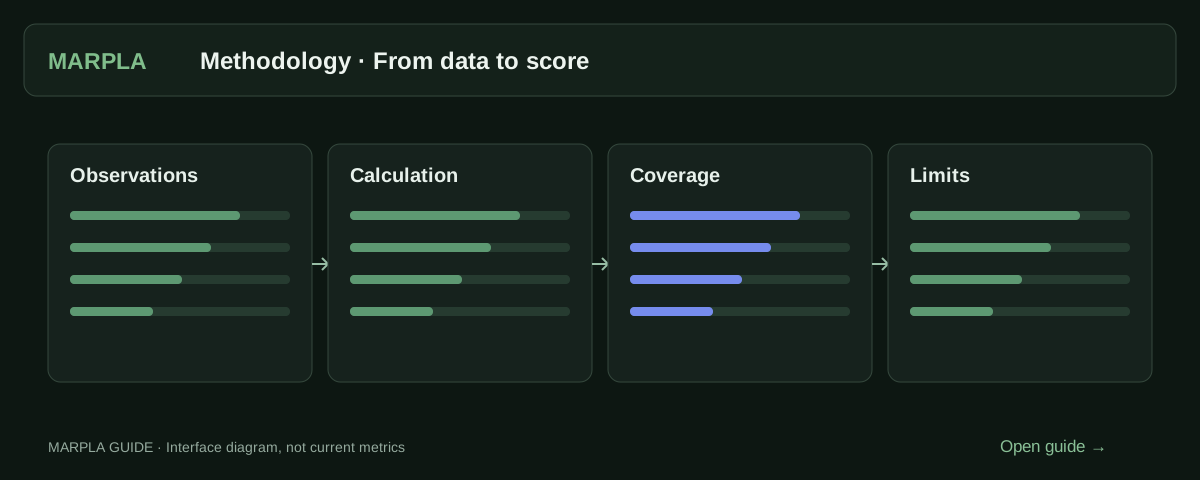
Open the sources and score components in Analysis. Check data coverage and formula limitations before using a signal to shortlist games.
- Start analyzing a gamePublic analysis helps you explore a game's audience, activity and rating.Step-by-step guide →
- Understand scores and riskScores help you choose projects for a closer look.Step-by-step guide →
Continue exploring
More on this topic →
Observed CCU history for Roblox games
Inspect saved concurrent-player samples with honest gaps, timestamps and range controls.
Read article
Roblox market analytics built from public observations
Track public Roblox experience signals in one catalog while keeping owner-only analytics separate.
Read article
Compare Roblox games on the same evidence
Place selected experiences on shared charts and separate real differences from timing and coverage artifacts.
Read article
Discussion0
Loading comments…