Data & methodology
MARPLA methodology essentials: sources, derivations, privacy
Separate every value into three layers: a public Roblox observation, a MARPLA derivation from saved observations, or authorized owner analytics. Keep its source, definition, observation time, and availability status. Missing data is not zero, and a derived estimate is not an official Roblox KPI.
Action essentials
Make the claim reproducible and proportionate
Public collection is bounded and rotates across saved games. Rate limits and partial responses can create gaps, so coverage accompanies interpretation. Derived session estimates, growth changes, confidence bounds, and the scouting score help prioritize review; their assumptions and risk labels travel with the value. They do not prove profitability or future success.
Private analytics requires the owner or a role with sufficient permission. Use minimal access, protect credentials, and retain only what the decision needs. For every conclusion, write the exact claim, evidence, inference, limitation, action, and next check. If another reviewer cannot reconstruct the claim from those fields, the methodology is incomplete.
When a source or formula changes, append a correction rather than overwriting the earlier decision record. Reproducibility includes the history of changed assumptions.
- Classify the data layer.
- Record source, definition, time, and coverage.
- Separate observation from inference.
- Attach a decision, limitation, and next check.
Primary sources
Put this into practice in MARPLA
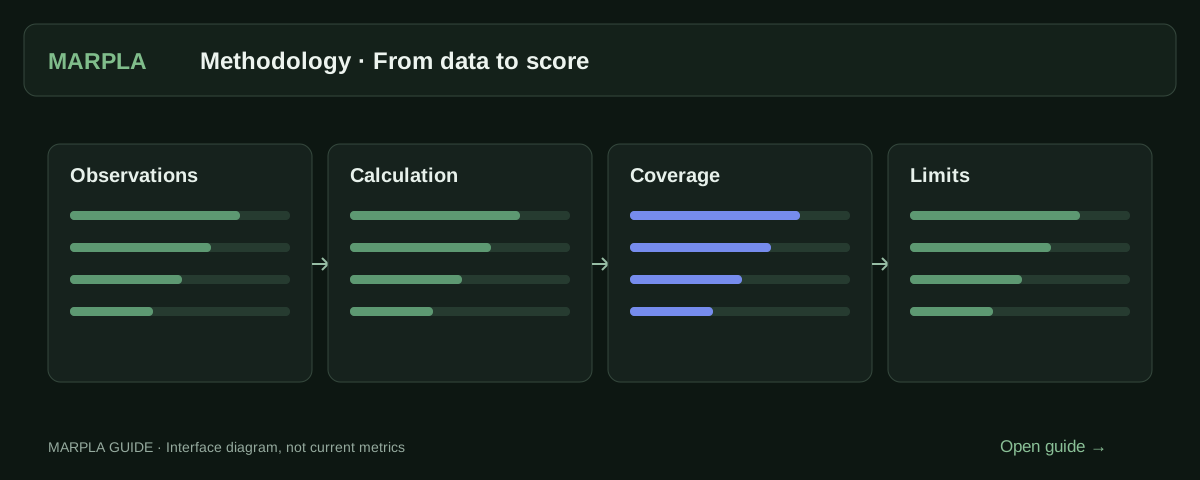
Open the sources and score components in Analysis. Check data coverage and formula limitations before using a signal to shortlist games.
- Start analyzing a gamePublic analysis helps you explore a game's audience, activity and rating.Step-by-step guide →
- Understand scores and riskScores help you choose projects for a closer look.Step-by-step guide →
Where this deep dive applies
Continue exploring
More on this topic →
MARPLA public-data methodology and privacy boundaries
Understand sources, sampling, derived metrics, access controls and the limits of public Roblox research.
Read article
A public-data evidence ledger for Roblox research
A reusable record for sources, timestamps, definitions, inference, limitations, and decisions.
Read article
Owner analytics diligence: access, evidence, and scope
A minimum-access checklist for verifying Roblox retention, acquisition, monetization, and operational claims.
Read article
Discussion0
Loading comments…