
Launch & promotion
How to improve a Roblox game's first session and retention
Low retention is not repaired by attaching a random daily reward. First observe what a new player expected, when they understood the goal, whether they performed the core action, received legible feedback, and saw a reason to return. The first session supplies early signals, the onboarding funnel locates loss, and D1/D7 reveal later return behavior. This guide connects qualitative observation with Creator Analytics without presenting genre benchmarks or individual cases as universal standards.
Full guide
Define the job of the first session
The FTUE should teach essentials, reach fun quickly, and expose future goals. Success is not “the tutorial ended.” A player should complete one meaningful loop: intention, action, result, feedback, and a next choice.
Editorial protocol: list observable states — join, goal understood, first action, result noticed, loop complete, next step chosen — plus death, empty server, blocked control, save failure, or exit. Do not narrate the route; that measures obedience to the producer.
Run an observed playtest, not a guided tour
Recruit people unfamiliar with the project and use a target device. Log where they look, press, pause, find success, and exit. Ask afterward: “What did you expect?”, “What changed?”, and “What next?” “Was that clear?” usually produces a useless yes.
Test limited screens, multiplayer, joins and leaves, delay, and empty matches. Studio supports client/server, Team Test, device emulation, and network simulation. A technical failure before the first fun resembles bad design in retention, so inspect crashes, FPS, errors, loading, and spawn behavior too.
- Let the participant open the game page and join without spoken context.
- Record actions and pauses; keep interpretations in a separate column.
- After friction, ask about expectation instead of explaining the correct answer.
- Repeat critical paths on target devices and in multiplayer conditions.
- Group repeated problems by funnel stage, device, and severity.
Turn the first loop into a server-validated funnel
Funnel events exist to locate losses in onboarding, progression, and shops. For a one-time first session, log completed actions in sequence: Player Joined, Equipped Tool, First Action, First Result, First Loop Complete, and Next Goal Viewed. Emit each event only after the server validates the action. A client click rejected by the server must not appear as a completed funnel step.
Events work only from the server in a published game. View Events validates the stream before charts populate. A later step can fill earlier ones, so bad ordering hides loss. After a step change, restrict the report to the new version and store an FTUE version in a controlled custom field.
Repair the loss mechanism, not the nearest metric
The largest drop is an investigation site, not an automatic answer. If players never press Play, the cause may be an unclear button, loading, an empty match, or a mismatch with the ad promise. If they complete a loop but do not continue, inspect enjoyment, feedback, reward, and the visibility of the next goal. If the first session looks healthy while D1 is weak, investigate traffic source, social context, progression, and the return reason.
Fix blockers and broken expectations first. Then remove waits, unnecessary menus, and lessons for mechanics that are not yet needed. A prompt should appear in the context of the action and disappear after success. Do not force a social game to start in an isolated tutorial place without testing that decision; it may postpone the value that brought the player in.
| Observation | Working hypothesis | Next check |
|---|---|---|
| Loss before first action | Goal or control is unclear | Simplify the screen and test a contextual prompt |
| Action occurs, result goes unnoticed | Feedback is weak | Clarify world change, sound, and reward |
| Loop completes, no continuation | Next goal is invisible | Surface a choice, progress, and future value |
| Drop on one device | UI, performance, or controls | Reproduce with that device profile and inspect errors |
| D1 changes with source mix | The audience composition changed | Compare mature source cohorts, not the overall mean |
Read retention only from mature cohorts
The retention axis in Creator Analytics is keyed to first-play date. D1 reports a cohort's return the next day, D7 the return after a week, and D30 after a month. Recent D7 and D30 points are naturally empty until enough time passes. Compare equally mature cohorts and annotate release time, campaign, weekend, outage, and source change. A large influx of new users can temporarily change the average by itself.
Use daily cohorts for a local change and weekly cohorts for the broader pattern. Break down source, platform, country, or another available dimension, but avoid tiny cells where one player changes the conclusion. Do not say “the new tutorial lifted D7” until its cohort reaches D7. A before-and-after chart shows association; seasonality, traffic composition, and concurrent changes remain alternative explanations.
Use cases for hypotheses and experiments for causality
On DevForum, the Zombie Zone developer described a sequence: moving newcomers into a separate solo tutorial place accompanied a drop in session time and D1; contextual guidance in the main multiplayer loop plus shorter intermissions then showed improvement. This first-person case is useful evidence about the risk of isolated instruction, but it does not prove that solo tutorials are always harmful. Genre, audience, and the simultaneous downtime change limit transferability.
With sufficient traffic, Roblox Experiments can randomly assign variants and measure causal impact. The documentation specifies 14–60 day experiments and asks teams to inspect minimum detectable effect; games below 1,000 DAU may struggle to obtain useful power. Pre-register one hypothesis, a goal metric, and guardrails. At low traffic, use observed tests and sequential versions while describing the weaker causal evidence honestly.
Worked hypothetical diagnostic cycle
An illustrative co-op mining game loses many players between receiving a pickaxe and the first swing. Playtest recordings reveal that a starter-pack modal covers the control on phones, while ad-acquired players expect to see the cave depicted in the creative. The team removes the obstruction and moves spawn beside a visible ore vein. Both changes address a confirmed blocker to the promised action, although the release log still lists them separately.
View Events confirms the instrumentation. First-action completion rises after publication, but the D1 judgment waits for cohort maturity. The source breakdown later shows improvement on mobile across several sources, while Sponsored Ads still underperform after the first loop. The next test changes the ad promise instead of attaching a generic daily reward. Each response now follows an observed break in the journey.
Mistakes, FAQ, and next-week plan
Mistakes include teaching every system before the first fun, treating completion as proof of enjoyment, logging an attempt as success, changing steps inside the selected reporting range, comparing immature D7, repairing a traffic-source problem through the core loop, and copying another genre's percentage. FAQ 1: is a tutorial mandatory? No; a clear first loop is mandatory, and the format should be tested. FAQ 2: how many steps? Enough to represent player decisions without implementation noise. FAQ 3: which matters more, D1 or funnel? They answer different questions: the funnel locates early loss, while D1 measures return.
Plan: day 1, map the first loop and validate events; day 2, observe tests on target devices; day 3, fix one demonstrated blocker; day 4, repeat technical paths and publish with a version marker; days 5–7, monitor errors, source mix, and funnel completion. Review D1 only after its cohorts mature and D7 later still. Record what evidence confirmed, what remains a hypothesis, and which single uncertainty the next cycle will reduce.
Before the next advertising launch
Review objectives, audience, loss limits and stopping criteria in the smart Roblox advertising guide. It separates paid cohorts from organic Home and shows the MARPLA tools used to make the decision.
When reach and audience composition change
Check source and cohort maturity before attributing lower averages to a worse game. The Home recommendations guide explains candidate selection, audience expansion, new countries and the corresponding MARPLA workflow.
Primary sources
- Roblox Creator Hub — Onboarding
- Roblox Creator Hub — Retention and mature cohorts
- Roblox Creator Hub — Funnel events
- Roblox Creator Hub — Event types
- Roblox Creator Hub — Analytics dashboard
- Roblox Creator Hub — Studio testing modes
- Roblox Creator Hub — Experiments
- DevForum — Zombie Zone, Dec 27, 2024–Jan 6, 2025
Put this into practice in MARPLA
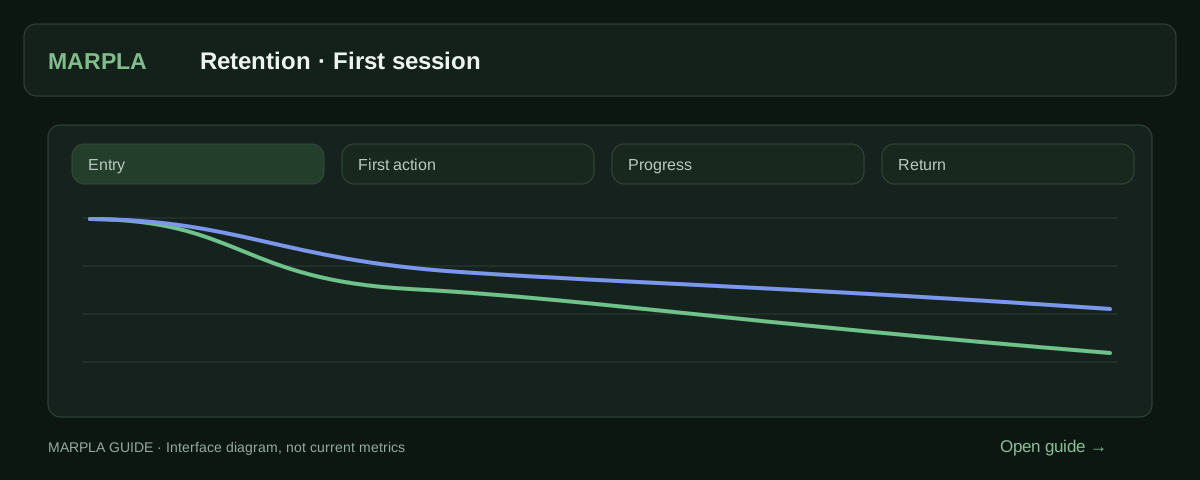
Locate early drop-off using retention and connected events. After changing onboarding, compare new cohorts to check whether more players reach their first meaningful action and return.
- Compare your game with benchmarksBenchmark scales show how your game performs alongside other projects.Step-by-step guide →
- View custom eventsCustom events track in-game actions, such as completing stages.Step-by-step guide →
Continue exploring
More on this topic →
A Roblox game launch and update plan: soft launch through review
A practical release checklist, source-level measurement, update operations, and community feedback loop.
Read article
Roblox ad creatives: a testing plan and results review
Test Roblox ad creatives with a hypothesis card, change log, and comparisons of CTR, plays, and spend. Includes a worked example and downloadable template.
Read article
Roblox Experiments: how to run A/B tests and improve your game
Set up Roblox Experiments, select metrics and evaluate A/B tests: 8 game test ideas, creator case studies, interpretation pitfalls and an experiment template.
Read article
Discussion0
Loading comments…