
Growth & updates
Roblox launch cohorts: measure an update without mixing sources
Launch-day CCU shows load and momentary scale, but not release quality. Product decisions need version cohorts, acquisition sources, and measures that have matured.
Focused deep dive
Time and source matrix
Separate Home, Sponsored, Search, Friends, Teleport, and unique share links. Other does not identify an outside channel. Record build and release time, then compare matching weekdays and complete windows. A funnel can reveal a blocker quickly, ad attribution lags, D1 needs the next day, and D7 needs a week.
Blended D1 can move because source shares changed while each source remains stable. For a new build, inspect completion, errors, and performance immediately, D1 after maturity, and D7 later. Do not wait for D7 before rolling back data loss.
| When | Decision | Measures |
|---|---|---|
| Opening minutes/hours | Safety and availability | Join, errors, receipts, persistence |
| Complete day | First loop and delivery | Funnel, source mix, reporting coverage |
| Mature D1 | New-cohort return | D1 by version/source |
| Mature D7+ | Durability | D7, playtime, monetization with limits |
Postmortem as a decision
Suppose an update and Sponsored campaign start together, CCU doubles, and blended D1 falls. Home D1 is stable, Sponsored is weaker, and the funnel shows pre-combat loss only for the new version on phones. The release has a mobile FTUE problem, while paid mix also lowers the average; advertising does not receive all the blame.
Use a MARPLA milestone, hypothesis note, and traffic comparison. Separate facts, limits, decisions, and one owner in the postmortem. Before/after does not establish causality when price, creative, and content changed together.
- Record build, release time, and channels.
- Review early safety measures.
- Compare sources in equally mature windows.
- Decompose mix and within-source change.
- Mark concurrent changes.
- Assign one decision and review date.
Primary sources
Put this into practice in MARPLA
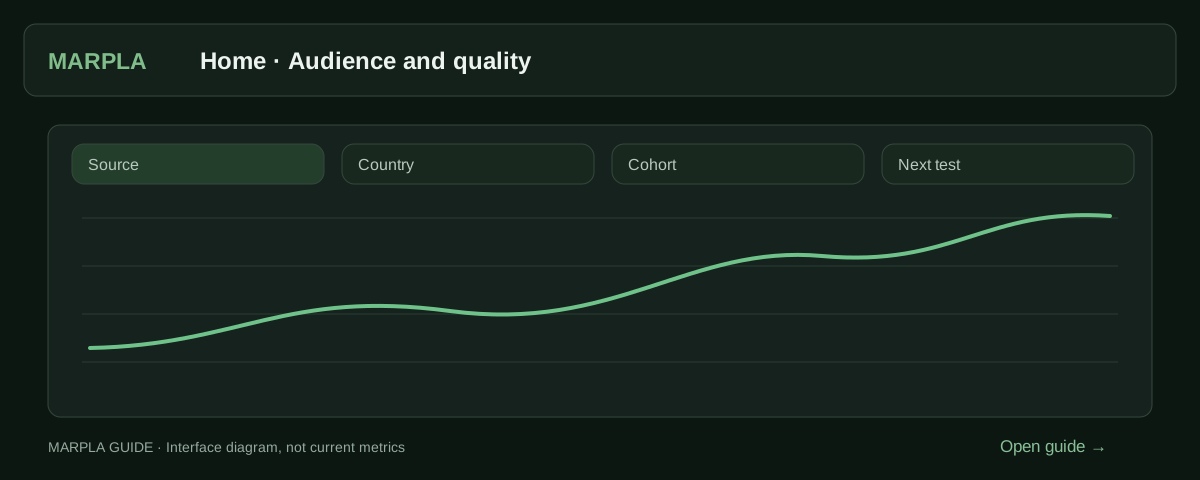
Separate organic Home from other sources, inspect countries and supported joint breakdowns, then relate audience changes to Home set history and record a hypothesis in a note.
- Compare audience composition and qualityCompare a complete period with its predecessor and separate audience mix change from within-segment metric change.Step-by-step guide →
- Investigate Home and new audiencesCheck source, countries and cohort maturity to separate audience-mix changes from a worse game experience.Step-by-step guide →
- Compare Home creatives and setsDistinguish set changes from statistics days.Step-by-step guide →
Where this deep dive applies
- Roblox Home recommendations: get discovered and sustain growth
- Roblox advertising: when to launch, how to target, and when to stop
- Roblox thumbnails: screenshots, staged scenes and practical testing
- How to improve a Roblox game's first session and retention
- A Roblox game launch and update plan: soft launch through review
- Roblox Experiments: how to run A/B tests and improve your game
Continue exploring
More on this topic →
Roblox launch operations: access, roles, stop conditions, rollback
A practical runbook for a release or major update without chaotic publishing.
Read article
Paid and organic Roblox traffic: avoid attribution errors
Separate Ads Manager, Acquisition, and organic Home when evaluating advertising.
Read article
A Roblox game launch and update plan: soft launch through review
A practical release checklist, source-level measurement, update operations, and community feedback loop.
Read article
Discussion0
Loading comments…