
Growth & updates
Roblox Home thumbnail personalization: read an adaptive test
Home personalization adaptively allocates variants to players. Unequal impressions and different segments mean a simple percentage comparison does not establish a causal image effect.
Focused deep dive
A stable set of distinct motivations
Build several truthful concepts such as action, progression, social play, or threat only when they exist in the game. Roblox recommends retaining several variants and avoiding rapid restarts; practical seven-day guidance does not guarantee adequate evidence.
Record images, date, title, game version, ads, and outside events. Avoid daily simultaneous changes. MARPLA set history shows saved counters and variant contributions; replacement-day counters may combine, and gaps are marked separately.
| Result | Supported conclusion | Next action |
|---|---|---|
| Few impressions | Evidence is insufficient | Continue without artificial spend |
| Variant gets more plays | Useful under current allocation | Retain and inspect entry quality |
| High PTR, high bounce | Promise attracts but entry disappoints | Check fidelity and FTUE |
| Leader changes after expansion | Segments may respond differently | Inspect mix; no universal winner |
Example without false precision
Suppose A receives 10,000 impressions and 400 plays while B receives 10,000 and 450: 4% versus 4.5%, a 0.5 percentage-point difference. Even equal volumes need not mean equal audiences. Without variant-level quality, B cannot receive credit for blended D1 growth.
The decision may remain operational: retain multiple supported motivations, remove a misleading variant, or design a focused follow-up. Preserve the live PTR tooltip because older qPTR material may use another definition.
- Create distinct, accurate hypotheses.
- Keep the set and event log stable.
- Review volume, allocation, and maturity.
- Connect entry with bounce or later behavior only when the breakdown exists.
- State the result at observation level.
Primary sources
Put this into practice in MARPLA
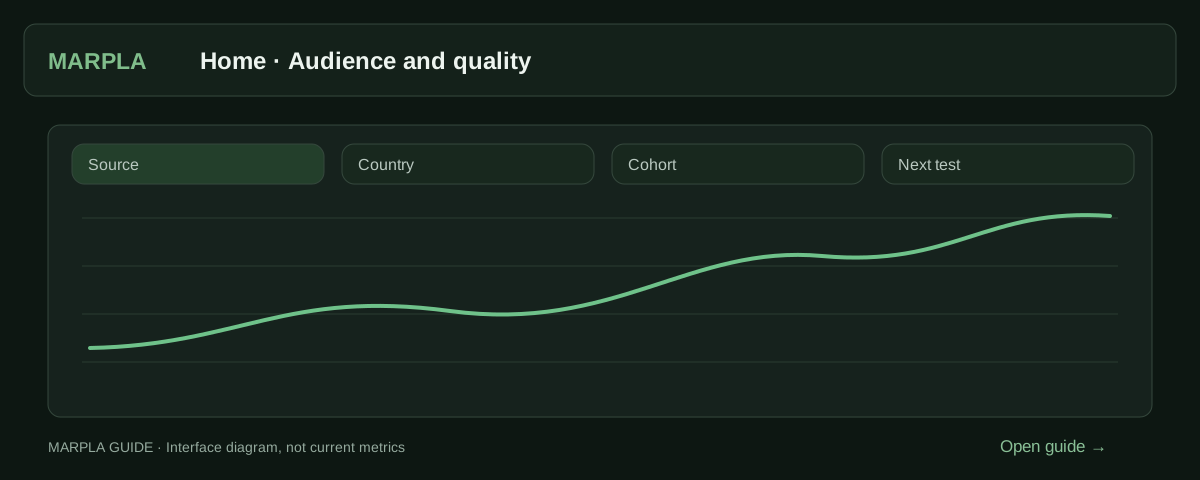
Separate organic Home from other sources, inspect countries and supported joint breakdowns, then relate audience changes to Home set history and record a hypothesis in a note.
- Compare Home creatives and setsDistinguish set changes from statistics days.Step-by-step guide →
- Investigate Home and new audiencesCheck source, countries and cohort maturity to separate audience-mix changes from a worse game experience.Step-by-step guide →
- Compare audience composition and qualityCompare a complete period with its predecessor and separate audience mix change from within-segment metric change.Step-by-step guide →
Where this deep dive applies
Continue exploring
More on this topic →
Roblox Home PTR and early exits: find the weak stage
A diagnosis of impressions → play → first session without mixing metrics.
Read article
Roblox thumbnails: screenshots, staged scenes and practical testing
Choose Roblox thumbnails, structure the game-page gallery and test Home images: screenshots versus renders, PTR/qPTR, creative briefs and a practical workflow.
Read article
Roblox creative brief and gallery: promise to sequence
Choose a truthful concept, test comprehension, and build a non-repetitive gallery.
Read article
Discussion0
Loading comments…