
Growth & updates
Roblox country cohorts: explain audience-mix changes
Country is a diagnostic breakdown, not a label for player quality or a published control for Home distribution. Compare segment share and within-segment performance while preserving source, platform, language, and cohort maturity.
Focused deep dive
Decompose the average
A blended metric changes because segment shares changed, within-segment results changed, or both. Calculate each available country's contribution as player share × segment metric, then compare periods. This is descriptive decomposition; it does not reveal why Roblox changed reach.
Hypothetical example: country A supplied 80% of players at 20% D1 and B supplied 20% at 10%, producing 18% overall. After expansion, shares become 40% and 60% with unchanged country results, producing 14%. Neither country worsened; the mix changed. These numbers are invented and are not benchmarks.
| Question | Needed evidence | Limit |
|---|---|---|
| Did mix change? | Players or new players by country and period | Does not explain distribution mechanics |
| Did experience weaken? | Mature metric within country | Small cells are unstable |
| Is localization involved? | Language, funnel steps, feedback | Country is not language |
| Is device involved? | Platform/OS and performance | Needs a joint breakdown or separate test |
Move from observation to decision
Do not disable a market merely because monetization or the blended average is weaker. Check availability, loading, text, pricing, controls, and the first loop. If a country grew together with a new acquisition source, geography alone cannot receive the credit or blame.
In MARPLA, compare complete periods and store the explanation as a hypothesis in a note. Use supported Creator Hub breakdowns; Roblox documentation notes that some filters are unavailable for some metrics.
- Choose equal complete windows and a mature metric.
- Record country shares and within-country performance.
- Check language, platform, and source where supported.
- Assign a testable repair to one observed mechanism.
Primary sources
Put this into practice in MARPLA
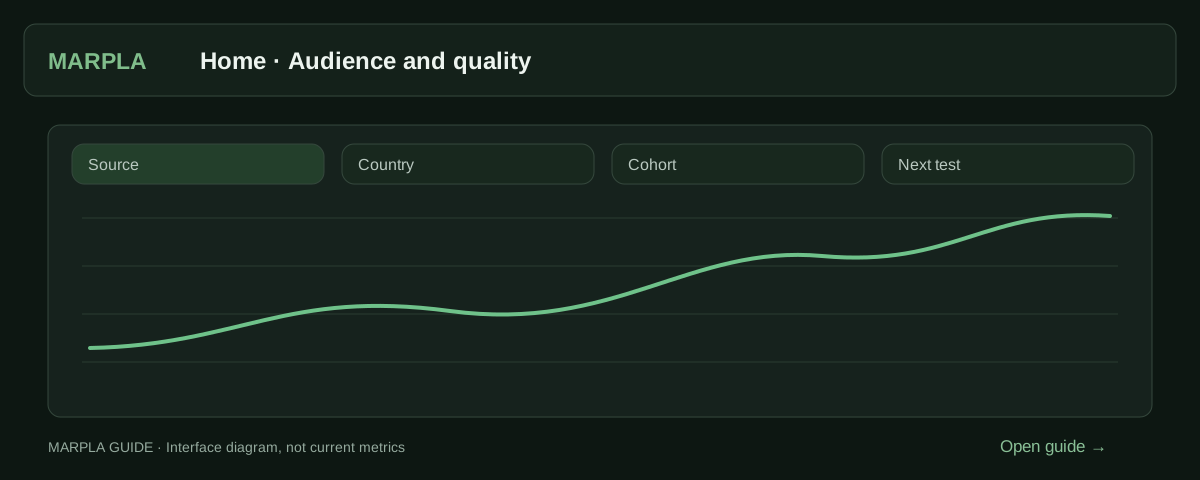
Separate organic Home from other sources, inspect countries and supported joint breakdowns, then relate audience changes to Home set history and record a hypothesis in a note.
- Compare audience composition and qualityCompare a complete period with its predecessor and separate audience mix change from within-segment metric change.Step-by-step guide →
- Investigate Home and new audiencesCheck source, countries and cohort maturity to separate audience-mix changes from a worse game experience.Step-by-step guide →
- Compare Home creatives and setsDistinguish set changes from statistics days.Step-by-step guide →
Where this deep dive applies
Continue exploring
More on this topic →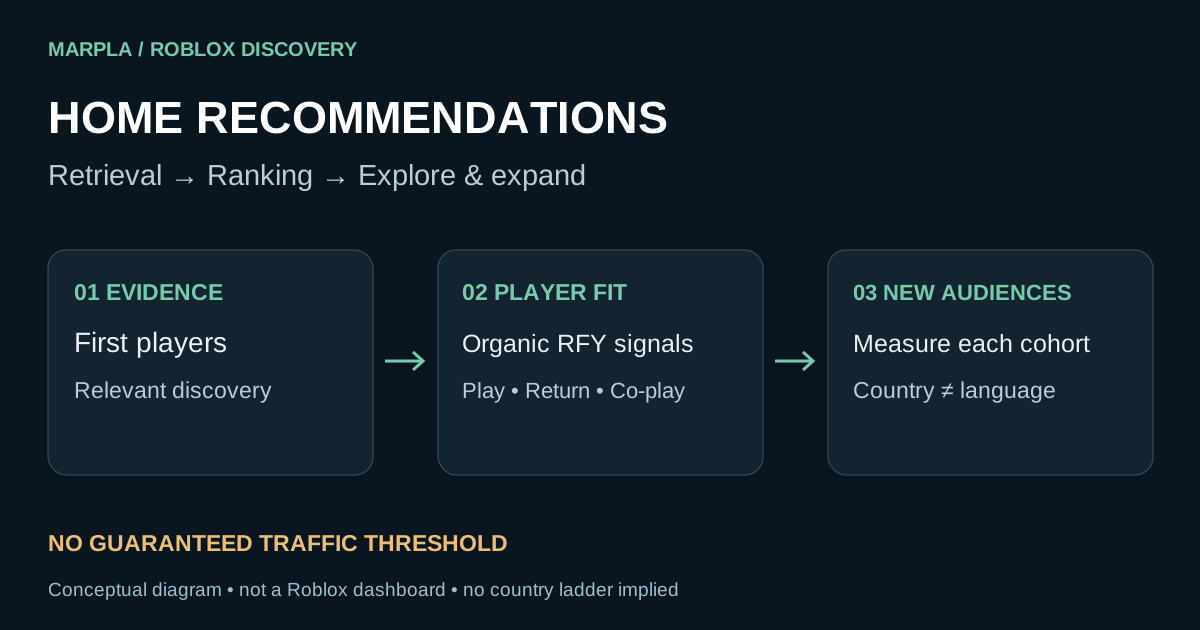
Roblox Home recommendations: get discovered and sustain growth
How Roblox tests and expands Home recommendations, what signals matter, and how to diagnose country mix and falling metrics with MARPLA.
Read article
Roblox localization and performance: diagnose early exits
Separate unclear language, technical delay, and promise mismatch for a new segment.
Read article
Roblox launch cohorts: measure an update without mixing sources
Comparable windows, sources, D1/D7 maturity, and a release postmortem.
Read article
Discussion0
Loading comments…