
Growth & updates
Roblox localization and performance: diagnose early exits
A weak result in a newly reached country does not make that market inherently poor. Players may not understand the goal, may wait through loading, or may encounter a game unlike the artwork. Separate these mechanisms before changing the product.
Focused deep dive
Three diagnostic branches
Localization: verify the source language, supported languages, critical first-loop strings, truncation, and reward meaning. Automatic translation fills blank entries and does not overwrite manual translations; review critical strings in context with a human.
Performance: reproduce entry on a representative device and network; compare loading, errors, FPS, memory, and time to first control. Promise: align thumbnail, detail page, and the opening minutes. The branches may coexist, so repair one demonstrated cause per cycle.
| Symptom | Possible mechanism | Check |
|---|---|---|
| Exit before first step | Loading or unclear spawn | Profiling and observed playtest |
| Failure at one task | Translation, truncation, context | Language screenshot and funnel step |
| Entry succeeds, expectation fails | Inaccurate creative promise | Match image to actual game moment |
| Issue isolated to platform | Controls or performance | Platform/OS breakdown and device test |
Hypothetical example and decision
Suppose bounce rises after Portuguese-speaking mobile players expand. On a representative phone, a long string covers the action button and the first area streams late. The team fixes layout and loading, validates events in View Events, and marks the release. Rewards and artwork remain unchanged, so the next window answers a narrower question.
Translation alone does not prove impact. Compare matching mature cohorts, errors, and first-action completion. With little volume, describe the result as an observation.
- Choose one language, platform, and loss step.
- Review UI in game context, not only a string table.
- Profile entry and first control on the target device.
- Release one repair, mark the version, and wait for the relevant window.
Primary sources
Put this into practice in MARPLA
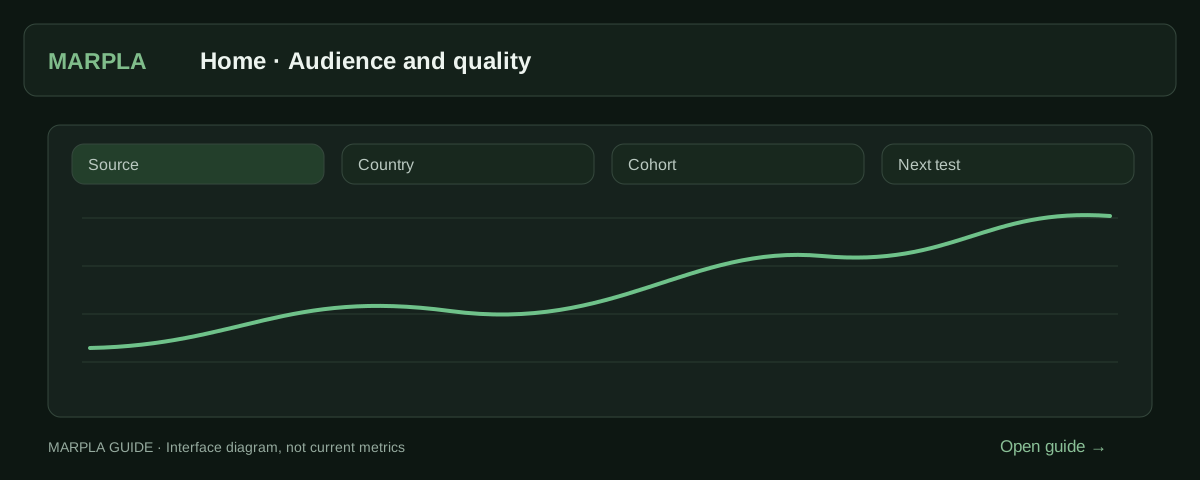
Separate organic Home from other sources, inspect countries and supported joint breakdowns, then relate audience changes to Home set history and record a hypothesis in a note.
- Investigate Home and new audiencesCheck source, countries and cohort maturity to separate audience-mix changes from a worse game experience.Step-by-step guide →
- Compare audience composition and qualityCompare a complete period with its predecessor and separate audience mix change from within-segment metric change.Step-by-step guide →
- Compare Home creatives and setsDistinguish set changes from statistics days.Step-by-step guide →
Where this deep dive applies
Continue exploring
More on this topic →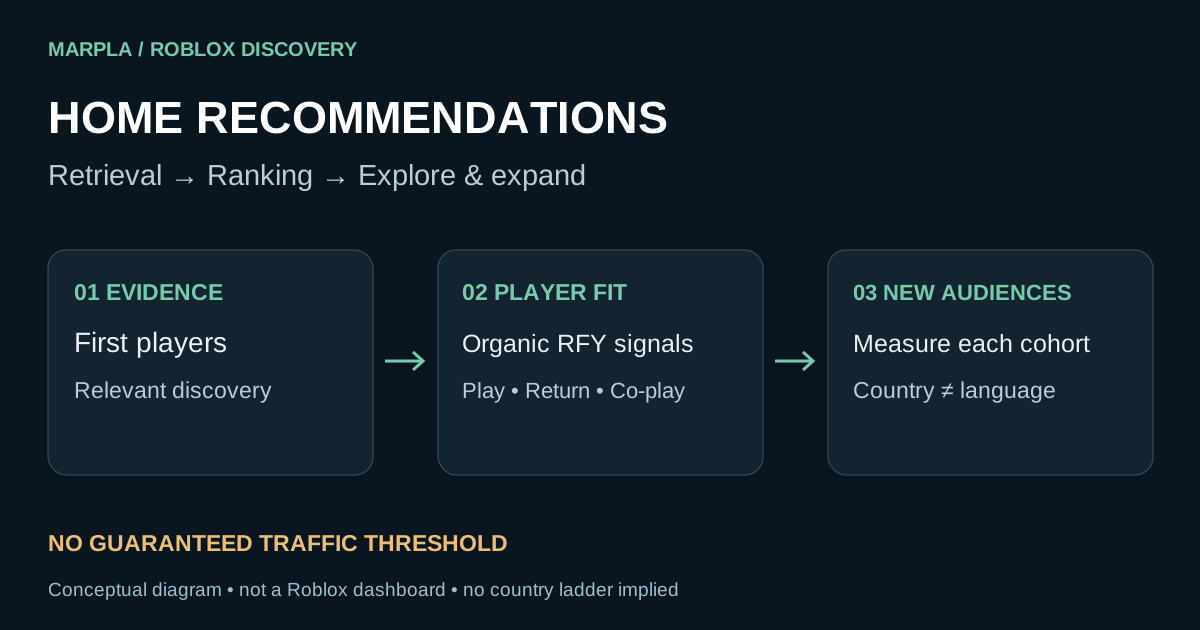
Roblox Home recommendations: get discovered and sustain growth
How Roblox tests and expands Home recommendations, what signals matter, and how to diagnose country mix and falling metrics with MARPLA.
Read article
Roblox country cohorts: explain audience-mix changes
A practical country-mix analysis without invented thresholds or country-quality labels.
Read article
How to improve a Roblox game's first session and retention
Move from observed playtests and an onboarding funnel to mature D1/D7 cohorts and testable changes.
Read article
Discussion0
Loading comments…