
Growth & updates
Roblox launch operations: access, roles, stop conditions, rollback
On launch day, availability, data integrity, and purchase fulfillment come first. Product measures mature later; technical harm needs an immediate response.
Focused deep dive
Before opening access
Exercise join, first loop, death and respawn, reconnect, persistence, purchase fulfillment, teleport, private server, and exit on claimed platforms. Test an empty server, latency, localization, maturity, and multiplayer. Prepare the prior stable version and a named rollback decision maker.
Assign release, technical response, community, and metrics owners. Record build, change list, known risks, launch window, channels, budgets, and hard stops. New games are private by default. Public Beta limits normal Recommended for You participation, while Sponsored Ads and analytics may still create separate observations.
| Signal | Response | Record |
|---|---|---|
| Data loss | Stop or roll back | Build, affected cohort, recovery |
| Widespread join failure | Close inflow and diagnose | Platform, errors, time |
| Purchase not fulfilled | Stop sale or release | Product, receipts, scope |
| Weak early metric without harm | Wait for mature window | Hypothesis and review time |
One log and few changes
After opening, verify a real join through every channel. Watch availability, errors, DataStore, receipts, teleports, queues, matchmaking, and repeated reports. Avoid emotional publishes every few minutes: each one changes the journey and comparability.
For an urgent fix, record exact time, build, and cohorts exposed. Community reports are signals, not audience share; group them and reconcile with telemetry. Once stable, send product decisions to the mature review.
- Verify critical paths and rollback.
- Assign roles and hard stops.
- Open access in the logged window.
- Verify channels through real joins.
- Execute technical stop rules immediately.
- Move mature measures to the postmortem.
Primary sources
Put this into practice in MARPLA
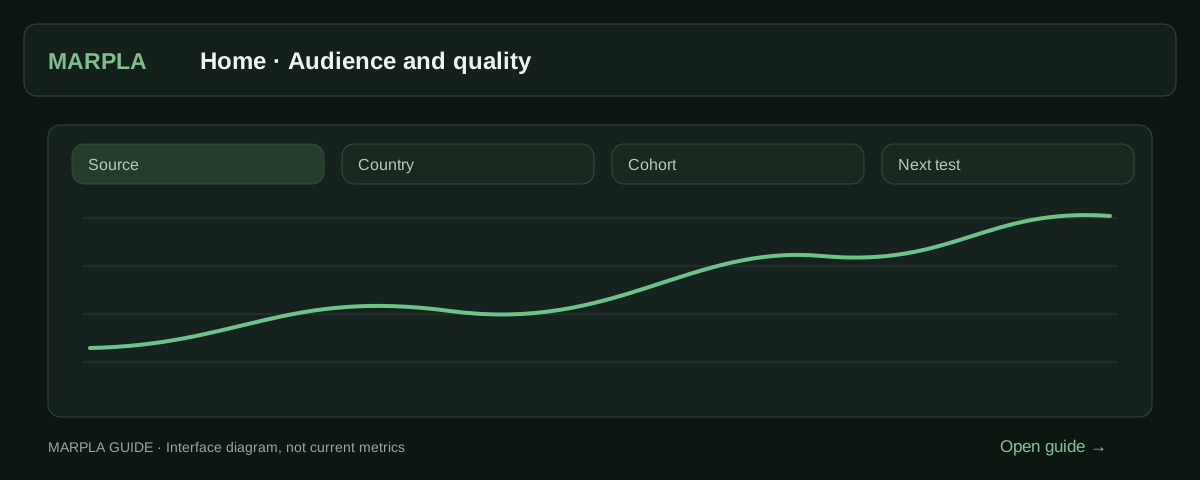
Separate organic Home from other sources, inspect countries and supported joint breakdowns, then relate audience changes to Home set history and record a hypothesis in a note.
- Add a milestone and track its resultA milestone marks a game change: an update, advertising, a new price or artwork.Step-by-step guide →
- Investigate Home and new audiencesCheck source, countries and cohort maturity to separate audience-mix changes from a worse game experience.Step-by-step guide →
- Compare audience composition and qualityCompare a complete period with its predecessor and separate audience mix change from within-segment metric change.Step-by-step guide →
Where this deep dive applies
Continue exploring
More on this topic →
Roblox launch cohorts: measure an update without mixing sources
Comparable windows, sources, D1/D7 maturity, and a release postmortem.
Read article
Roblox first-session diagnosis: from loss shape to repair
Combine observed playtests, first-session retention, funnels, and mature D1.
Read article
A Roblox game launch and update plan: soft launch through review
A practical release checklist, source-level measurement, update operations, and community feedback loop.
Read article
Discussion0
Loading comments…