
Launch & promotion
Roblox advertising: when to launch, how to target, and when to stop
Buy advertising to support a specific decision: validate the product, compare promises, or scale defensible economics. Set a loss limit before launch, then separate delivery, player quality, and organic traffic. High CTR, higher CCU, and an attractive Signal score cannot individually justify continued spend.
Full guide
Start with the decision your spend should support
Run ads when you can name a testable question and the action that follows its answer. “Increase CCU” is too vague: the increase may last only while you pay. Useful questions include whether new players complete the first loop, which creative promise attracts a suitable audience, whether reacquisition adds value, and whether a proven setup can scale profitably.
| Decision | Measure | What it does not establish |
|---|---|---|
| Product validation | First-loop completion, join failures, early exits, mature cohorts | Cheap plays do not establish readiness to scale |
| Creative test | Comparable impressions, CTR, plays, spend, and quality where attributable | The highest CTR does not mean the best economics |
| Profitable growth | Incremental cohort value over a chosen window minus its cost | Attributed revenue is not necessarily incremental revenue |
| A specific eligibility objective | Progress toward that objective’s requirement | Meeting a requirement does not guarantee organic growth |
Separate research spend from scaling spend. Research purchases an answer and may not pay back; scaling needs a defensible economic case. Do not continue research merely because you have already spent money: sunk spend does not make the next dollar more useful.
When a game is ready for a paid test
Before buying traffic, play from a new account on the intended devices. Check loading, controls, the first action, delivery of the promised reward, saved progress, and server errors. For a cooperative game, test an empty server separately: an ad-acquired player may arrive first and encounter a different product from the one your team playtested.
There is no invented universal D1 target suitable for every genre. You need functioning measurement, an understanding of the main losses, and the ability to improve the product afterward. If players never reach an understandable first success, a large budget will reproduce the problem faster. A bounded pilot can still be useful for diagnosis, provided that is the recorded decision rather than a profit promise.
Before launch, record the game version, intended audience, creative promise, loss limit, review date, and owner. Separately retain organic-source data and available mature cohorts. Use chart notes in MARPLA and investigate early exits with the first-session guide.
For early research, consider Experience Beta: Roblox supports paid testing before a game participates in Home recommendations. This is useful while first-time onboarding is still being repaired. Check the current Beta setting before expecting organic growth: no Home traffic in that mode does not demonstrate advertising harm.
Can advertising hurt organic traffic?
Three things are easy to confuse: a lower overall average, worse product performance, and changing organic distribution. Roblox separates candidate retrieval from Recommended for You ranking: other sources can help a game be considered, but ranking uses users from that recommendation surface rather than users first acquired through ads. This is the current documented Discovery model, not a guarantee against platform defects.
A hypothetical arithmetic example: 100 organic new players produce 20 returns in a comparable mature cohort, or 20%. Another 100 ad-acquired players produce five returns. Overall retention becomes 25 / 200 = 12.5%, even though the organic group remains at 20%. This assumes disjoint groups and the same return definition; actual source rows can overlap. It illustrates composition, not the Roblox algorithm.
Harm is still possible: acquisition can lose money, the creative promise can mislead, and additional players can expose overload, poor matchmaking, or weak onboarding. Fix the identified mechanism. A Home decline coinciding with ad launch warrants investigation but does not establish causation. Updates, seasonality, thumbnail changes, and audience composition may have changed simultaneously.
There is another subtle effect: Roblox explains that a paid-acquired user may subsequently see the game in Continue instead of receiving a new RFY recommendation. Fewer RFY impressions therefore need not mean a penalty. This is Roblox’s stated behavior, not a guarantee against bugs. Its June 15, 2026 RFY update explicitly identifies organically acquired RFY users as the population behind ranking signals.
What developers’ actual reports show
Primary discussions and Roblox staff replies were reviewed on September 18, 2026. These are the authors’ own observations, not MARPLA-verified experiments. Numbers from different games are not benchmarks for yours.
| Source | Observation | Practical lesson and limitation |
|---|---|---|
| GET OUT, August–September 2026 | The author reports roughly 3% D1 with ads versus 5–8% without, alongside much lower average playtime. | Inspect acquisition source and the first funnel step. Roblox staff assigned the report for review but confirmed neither a bug nor an organic penalty. Adjacent weeks without a control do not establish causation. |
| Bingo Sabotage, September 2026 | The posted breakdown gives Sponsored D1 of about 1.52% versus Home at 0.952%. | Paid is not always the worst cohort. Sample sizes and uncertainty are unknown; this does not prove an advertising advantage. |
| 120,000-Robux case, August 2025 | A developer reports recovering costs and making a profit after iterating thumbnails, icons and the name. | Creative iteration is useful; the author’s eight credits daily for two weeks is personal experience. Complete economics and causality were not independently verified. |
| Home growth followed by decline, 2025 | The author describes growth after roughly 13 days of buying traffic followed by a substantial Home decline. | A sequence of advertising, growth and decline does not prove a fixed two-week boost. Early success does not guarantee durable demand. |
An experienced developer’s advice is useful when the game, date, objective, budget, audience and measurement are clear. Transfer the testable hypothesis, not a magic number. Recent Roblox explanations of system behavior carry more weight than older guesses about feeding the algorithm.
How to investigate suspected harm
- Record exact ad starts, pauses, budget changes, releases, and Home thumbnail changes.
- Compare Home impressions and plays separately from advertising. Total CCU is not a source breakdown.
- In Audience quality, compare matching complete periods and available segments: did segment weights or within-segment quality change?
- Check first sessions, retention maturity, devices, and countries. Leave unavailable breakdowns unknown.
- Check errors, server latency, and whether the creative promise matches the actual landing experience.
- If you choose a pause experiment, predefine the observation window and conditions. Do not change the game and all creatives simultaneously. Before/after remains observational; causal conclusions require a valid control.
MARPLA provides a descriptive decomposition of composition and quality changes. It helps choose the next check; it does not automatically identify advertising as the cause. Spend and audience data need compatible periods and time zones, and saved daily spend is not complete attribution. Audience quality instructions.
Choose the objective and audience
Choose according to the decision, not an attractive button label. Eligible objectives and audiences depend on the game and account; recheck Roblox options before creating a campaign. Ads Manager distinguishes Plays, Earnings, and Engagement; the last relates to Highly Engaged Players rather than being a generic retention-improvement switch.
| Scenario | Working choice | Why and what to check |
|---|---|---|
| Initial diagnostic pilot | Plays; a broad or contextual audience appropriate to the game | Use New Players only when eligible personalized 18+ users match the research question. This may not represent a children’s game. Cheap plays are not profit. |
| Established monetization | Earnings, if eligible | Check incremental value after cost, revenue maturity, and the risk of paying for users who would return anyway. |
| Bring players back for a meaningful update | An eligible recent or lapsed audience | Offer a real reason to return. Assess the effect separately from natural returns. |
| A specific Highly Engaged Players target | Engagement, if eligible | Use a separate cap and completion criterion. Do not compare its cost per play with Plays as if the tasks were identical. |
All Players can suit a broad hypothesis but makes a claim about specifically new-player acquisition harder to defend. Campaign audience settings and reporting user filters are different concepts: similar names do not guarantee identical time boundaries. Retain both with the export.
Earnings can produce a higher CPP because it seeks rarer spending-prone users: judge it by mature value, not CPP alone. For a new game with weak monetization, Roblox recommends starting with Plays. Do not treat naturally returning users and first-time acquired players as equivalent retention cohorts.
Targeting: what to constrain and why
Start with the simplest audience for which the question makes sense. Narrowing five fields at once tests that whole combination, not each attribute. First exclude conditions your product cannot support; then test a specific hypothesis separately. Do not choose US and Canada or a particular gender solely because someone else’s case recommended it.
| Setting | A reason to constrain it | When to stay broader |
|---|---|---|
| Countries and regions | Localization, server latency, or validated market economics | Quality evidence is weak or cheap clicks are the only reason |
| Devices | The game genuinely works poorly on some devices | Controls and performance are tested and quality differences remain unproven |
| Age and gender | A testable product hypothesis and an available control | Evidence is sparse or a stereotype is replacing research |
| Genres | The creative and core loop address a clear interest | Narrowing restricts delivery or the question is about discovering demand |
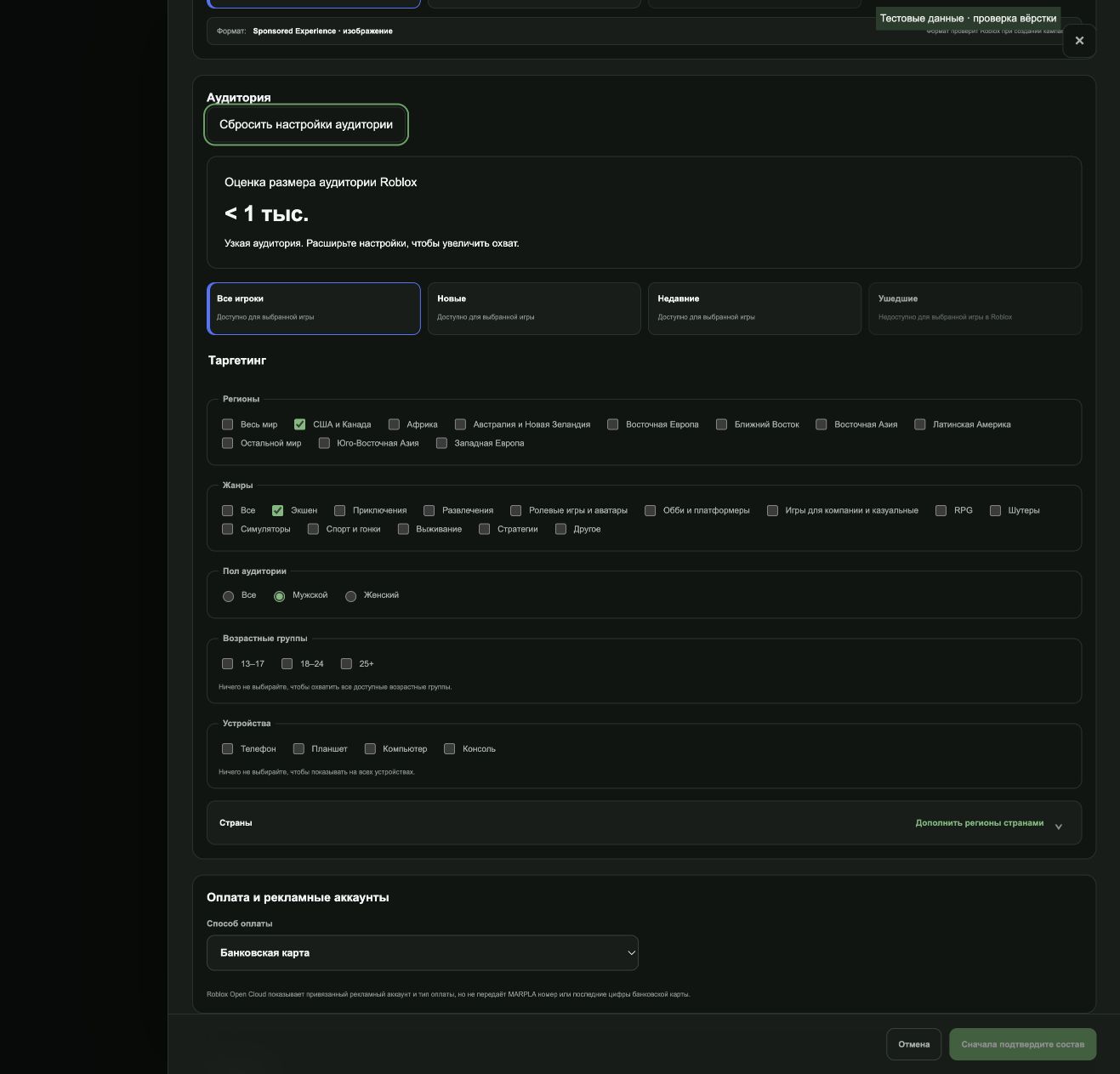
The audience estimate can expose overly narrow selection; it does not promise impressions, cost, or sales. Treat Audience quality hints as hypotheses rather than instructions to immediately retarget ads. MARPLA’s supported Engagement browser path does not accept manual targeting; use the options returned by Roblox.
Filters also have an eligibility boundary: Roblox explains that personalized audience, genre and gender options apply to eligible 18+ users who allow personalization; device and location are contextual restrictions. Selecting an interest therefore does not reach every child who likes a genre. The same announcement warns that narrowing can raise CPP and suggests comparing targeted and less restricted variants.
Budget, duration, and the price of an answer
First decide how much you can afford to lose to answer a specific question. Then allocate it across variants and time. If the budget cannot support comparable observations for each variant, reduce their number or narrow the question instead of dividing spend across dozens of nearly identical images. “Spend N Robux and the algorithm will pick you up” is not a plan.
In a MARPLA group test, the budget is per campaign; an image copy also creates a separate slot. Hypothetical arithmetic: 3 campaigns × $5 daily × 4 days = a planned $60 cap. This is an example, not a recommended budget or a prediction of actual billing. Check start, end, time zone, budget type, and the combined amount before confirmation.
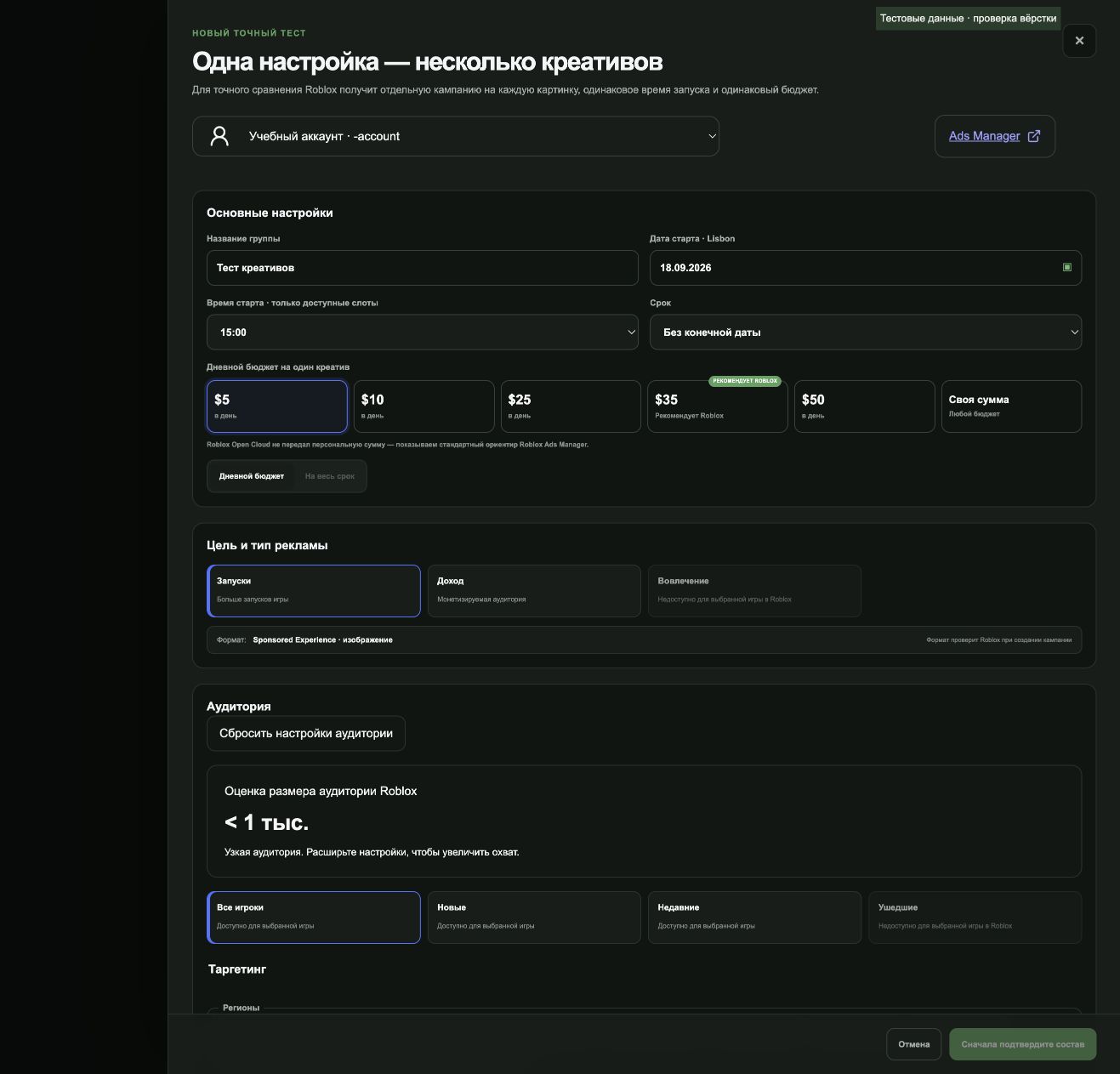
A daily cap controls pace, but an open-ended schedule still needs total-spend oversight. A lifetime cap bounds the run but does not make every day equally informative. Give variants comparable observation windows rather than selecting a winner in the first hours; stop immediately for breakage or a breached limit.
Separate delivery learning from outcome maturity. The February announcement described roughly a day of learning; the newer May update warns that pausing in the first 24–48 hours can restart learning and recommends beginning performance assessment after 7–10 days. This is guidance for a normal campaign, not an obligation to fund ten days at any cost. If your cap cannot support that observation window, reduce variants or label the test diagnostic. Review D1/D7 cohorts as they mature even after acquisition has stopped.
Single campaign, group test, or manual group?
| MARPLA tool | When to use it | Check |
|---|---|---|
| + Single campaign | One idea without a comparative test | Game, account, one creative, budget, confirmation |
| Group test | Several meaningfully different promises | Matching controllable conditions; one campaign per slot; combined cap |
| Manual group | Compare campaigns that already exist | Different goals, dates, and audiences. Grouping neither changes those settings nor creates campaigns |
Matching settings make a group useful for comparison, but do not randomly allocate equivalent players to variants. Delivery can differ. Retain an earlier control creative and a new hypothesis, then check actual impressions and spend. If image, region, and audience all change, draw conclusions about the combined setup.
Use the library to inspect an image’s history by campaign. An earlier high Signal identifies a retest candidate; it is not a guarantee for a new audience. Campaign setup · manual groups · detailed creative testing.
Which conversions should you compare?
Spell out the event in the test card: click, play, new unique player, first-loop completion, return, or purchase. “Conversion” without a denominator is ambiguous. Plays can include repeat activity, so cost per play is not cost per new player. Do not add advertising attribution to organic activity as if they were independent sales.
Current Ads Manager documentation allows up to 48 hours of reporting delay for plays and earnings and attribution of later activity for up to 30 days. A paused campaign can therefore continue receiving reported results. Keep the user filter, date range, and export time; revisit Roblox reporting definitions when the interface changes.
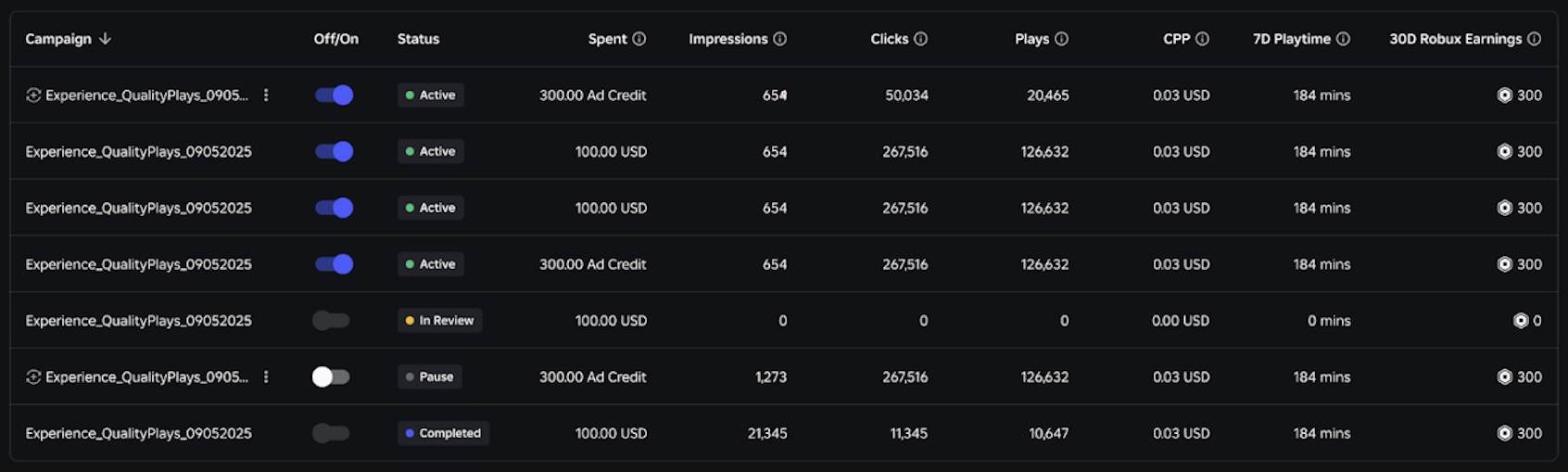
For acquired-player quality, inspect Acquisition by source: retention, cumulative playtime, and monetization have different maturity windows and definitions. Do not compare a new cohort with a mature one. Whole-game D1 cannot evaluate an individual image without separate attribution. Acquisition definitions.
The documented 48 hours describes normal reporting delay, not guaranteed finality. If past periods keep changing, preserve the timestamp of each snapshot, flag the reporting issue and defer winner claims. A MARPLA saved outcome for a stopped group remains a historical snapshot rather than an automatically maturing report.
Evaluate economics without inventing payback
Start with same-period ratios: CPP = actual spend / plays, and plays per dollar = plays / spend. A zero denominator gives an undefined result, not infinitely good performance. MARPLA’s clicks, impressions, plays, and hours per dollar help compare delivery and attributed time; none independently measures profit.
Hypothetical example: A spends $20 for 200 plays; B spends $30 for 450. CPP is $0.10 versus approximately $0.067, so B is cheaper for that event. If those are repeat plays by a small audience, however, a conclusion about new-user acquisition cost would be wrong. Add quality and value only at a level with reliable source and cohort matching.
Do not divide arbitrary Robux totals by dollars and call the result net profit. Record the monetary valuation applicable to your team, fees, costs, and horizon. Then ask what revenue advertising actually added versus what would have happened anyway. Without a control, this is an attributed-economics estimate with limitations, not proven incremental ROI.
Use MARPLA Signal within its limits
Signal is an internal relative score, not a Roblox assessment or a probability of winning. Compare campaigns within one group and reporting period, and creatives within a campaign when separate data exists. A multi-creative campaign’s totals cannot be assigned to every image.
In the checked version, the provisional conversion comparison requires each compared row to reach 1,000 impressions, 100 clicks, and 50 plays. The full comparison additionally needs at least five hours of playtime and $5 spend for every row. At least two eligible rows and matching periods are needed. These are MARPLA product thresholds, not statistical proof, a Roblox budget requirement, or an instruction to automatically stop other variants.
Inspect the underlying measures and confidence. Confirm that variants actually served, were not paused early, and pursued comparable objectives. Compare spend, hours, and plays per dollar, then investigate available player-quality data. A color or score starts the analysis; record the decision separately. Comparison rules · reporting.
When to pause ads and when to wait
| Situation | Action | Reason |
|---|---|---|
| Wrong game, account, budget, or promise; broken entry | Pause affected campaigns immediately | More spend is unnecessary to confirm a known fault |
| The predefined loss cap is reached | Pause and review | Learning does not override a loss limit |
| Sparse delivery, immature data, or reporting lag | Check delivery and wait for the next agreed window within the cap | An incomplete result does not establish that a variant lost |
| Cheap clicks but poor entry or first-loop behavior | Investigate the promise, landing, audience, and game; pause for confirmed problems | CTR cannot compensate for unsuitable traffic |
| Mature economics fail your acceptable threshold | Stop or run a new bounded test | Continuing needs a new testable hypothesis |
| The campaign’s objective is achieved | Review whether continued spend is needed and pause unnecessary delivery | Achieving the objective does not justify further spend |
| Only overall D1 fell and organic sources were not examined | Separate sources and composition before assigning cause | The aggregate can change because the audience mix changed |
Do not turn the calendar into a universal rule: “stop after 24 hours” and “always run seven days” are equally weak without an objective, budget, and data-maturity check. Scheduled reviews are necessary; repeatedly toggling campaigns over random movement makes the test harder to interpret. A serious fault or loss cap takes precedence over waiting for a perfect report.
When increasing the budget is justified
Increase spend when there are no critical failures, mature cohorts meet your quality thresholds, and additional acquisition has an acceptable cost or demonstrated value. Save a MARPLA baseline, record the budget change as a chart note and change one factor. There is no universal growth percentage: use your loss capacity, server capacity and eligible audience.
After increasing spend, inspect the latest added traffic rather than only the attractive average across the entire campaign. Auction conditions, audience mix and exposure can change; the previous CPP is not guaranteed. If new cohorts deteriorate, return to the previous limit or pause for diagnosis. When investigating creative fatigue, inspect delivery and outcome trends, then test a new truthful creative; do not change targeting and creative together without a separate hypothesis.
Pause in MARPLA and retain a useful result
- Select the game, account, group, and reporting period. Retain the original figures and pause reason in a card or note.
- Use the campaign switch or Pause all in the intended group. Hiding a row, disabling a chart line, or removing a favorite does not stop advertising.
- Check the response for every campaign. Group pause includes rows hidden by filters. On partial failure, successful changes remain; review affected campaigns and check Ads Manager.
- Check status and delivery separately after synchronization. A saved stop result is a historical snapshot, not confirmation of every current switch state.
- Revisit the same reporting window later because delayed attribution may add results. Start a new test with a new question and card while preserving the previous history.
Refresh does not promise instant completion of Roblox processing: MARPLA retains previously confirmed data when a response is incomplete. Inspect the period, retrieval time, and warnings rather than the fact that you clicked Refresh. Advertising synchronization.
Close the loop with Home, audience quality, and notes
After the ad test, check whether the promise fits the product. In Content → Home, compare sets and individual images only within their own periods. Change history can reveal that an organic thumbnail changed alongside advertising. Ad CTR and Home QPTR/PTR concern different surfaces; use the current source tooltip for the name and definition.
Use Audience quality to investigate aggregate changes, and notes to retain decisions and the next review date. Do not sum overlapping Home rolling windows as independent days. If the data cannot connect source, image, and mature cohort, record that limitation explicitly instead of inventing precision.
Home set history · Audience quality · milestones · public and owner data.
One controlled launch: the checklist
- Before launch: verified first loop, objective, conversion event, hypothesis, loss limit, and review plan.
- Before confirmation: game, account, audience, supported settings, duration, currency, and the combined cap across campaigns.
- After launch: moderation and delivery, change times, reporting completeness, matching periods, and attribution.
- At review: comparable conditions, the cost of the intended event, available cohort quality, and organic performance separately.
- At pause: confirmation for every campaign, a saved result, a later attribution check, and a specific next action.
Download the advertising decision card · Step-by-step MARPLA instructions.
When reach and audience composition change
Check source and cohort maturity before attributing lower averages to a worse game. The Home recommendations guide explains candidate selection, audience expansion, new countries and the corresponding MARPLA workflow.
Primary sources
- Roblox Creator Hub — Ads Manager
- Roblox Creator Hub — Discovery
- Roblox Creator Hub — Acquisition
- Roblox Staff — Home and paid acquisition
- Roblox Staff — RFY ranking update, June 2026
- Roblox Staff — Targeting and learning, February 2026
- Roblox Staff — Learning and attribution, May 2026
- Roblox Staff — Experience Beta
- Developer report — GET OUT (unconfirmed)
- Developer report — Bingo Sabotage
- Developer report — Creative iteration
- Developer report — Home growth and decline
Put this into practice in MARPLA
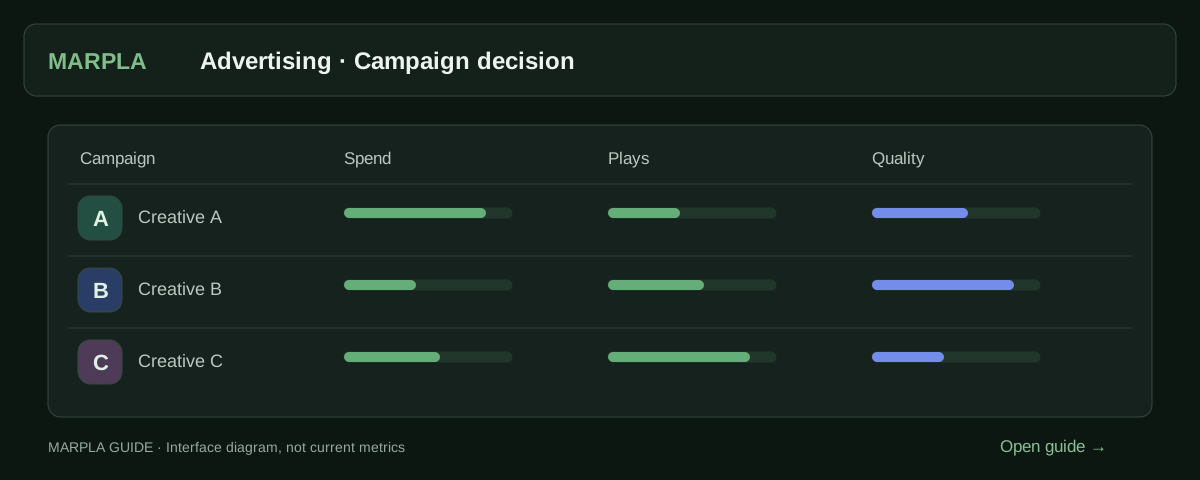
Record the objective and loss limit, create a bounded test and compare spend with player quality. Before stopping, save a snapshot and verify each campaign’s confirmed state.
- Launch, evaluate and stop advertisingRun a controlled launch, separate paid traffic from organic traffic, and verify that every campaign has stopped.Step-by-step guide →
- Compare audience composition and qualityCompare a complete period with its predecessor and separate audience mix change from within-segment metric change.Step-by-step guide →
- Compare advertising resultsReports help you see which campaigns bring players and at what cost.Step-by-step guide →
Continue exploring
More on this topic →
Roblox ad creatives: a testing plan and results review
Test Roblox ad creatives with a hypothesis card, change log, and comparisons of CTR, plays, and spend. Includes a worked example and downloadable template.
Read article
How to improve a Roblox game's first session and retention
Move from observed playtests and an onboarding funnel to mature D1/D7 cohorts and testable changes.
Read article
Public Roblox data vs owner analytics
Know what can be observed from the market, what requires permission, and where public estimates must stop.
Read article
Discussion0
Loading comments…