
Launch & promotion
Roblox Ads budgets and stop rules: economics of one answer
A test budget is the price of an answer, not a bet on guaranteed growth. Define the minimum useful evidence, maximum acceptable spend, and review point before publishing.
Focused deep dive
Calculate at one evidence level
Daily budget caps a day and lifetime budget caps the campaign; actual spend may be lower. Impressions and clicks arrive quickly, while plays and earnings can take up to 48 hours to appear and can include events attributed for up to 30 days. An early zero is not a final zero.
CPP = spend / attributed plays answers the cost of an attributed start. Cost per first-loop completion needs a reliable join-to-event link. ROI needs incremental value rather than all attributed revenue because some players might have arrived or spent without the ad.
| State | Action | Reason |
|---|---|---|
| No delivery | Check status, moderation, uniqueness, settings | No product conclusion is possible |
| Clicks, few plays | Check promise, destination, errors | The break is below the click |
| Plays, weak first loop | Stop scaling and repair entry | Spend multiplies the loss |
| Stable economics across windows | Increase in a separate step | New volume changes mix and price |
Pause and scale rules
Technical harm such as data loss, unavailability, or failed fulfillment calls for an immediate stop. Analytical uncertainty can wait until the recorded review date while spend remains capped and reporting matures. Sunk spend is not a reason to continue.
MARPLA Signal compares rows within one window; it is neither profit nor a Roblox metric. A full signal requires sufficient conditions for every compared row, so inspect its inputs. After stopping, verify each campaign state and save the snapshot as history rather than a current switch.
- Separate research and scaling budgets.
- Write the hard stop, loss cap, and review date.
- Compare spend rather than planned budget.
- Wait for the required attribution window.
- Record the decision and confidence level.
Primary sources
Put this into practice in MARPLA
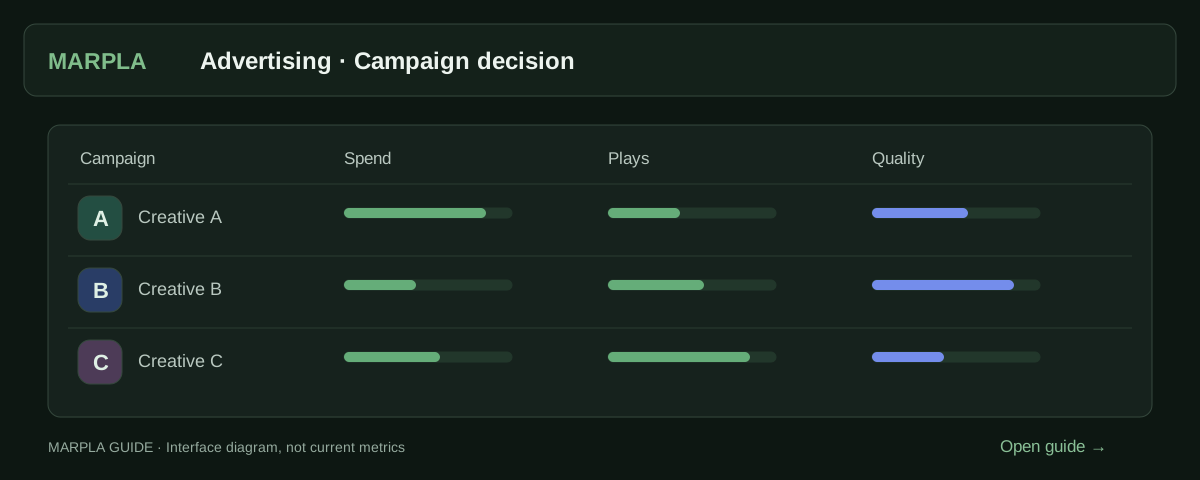
Record the objective and loss limit, create a bounded test and compare spend with player quality. Before stopping, save a snapshot and verify each campaign’s confirmed state.
- Compare advertising resultsReports help you see which campaigns bring players and at what cost.Step-by-step guide →
- Launch, evaluate and stop advertisingRun a controlled launch, separate paid traffic from organic traffic, and verify that every campaign has stopped.Step-by-step guide →
- Compare audience composition and qualityCompare a complete period with its predecessor and separate audience mix change from within-segment metric change.Step-by-step guide →
Where this deep dive applies
Continue exploring
More on this topic →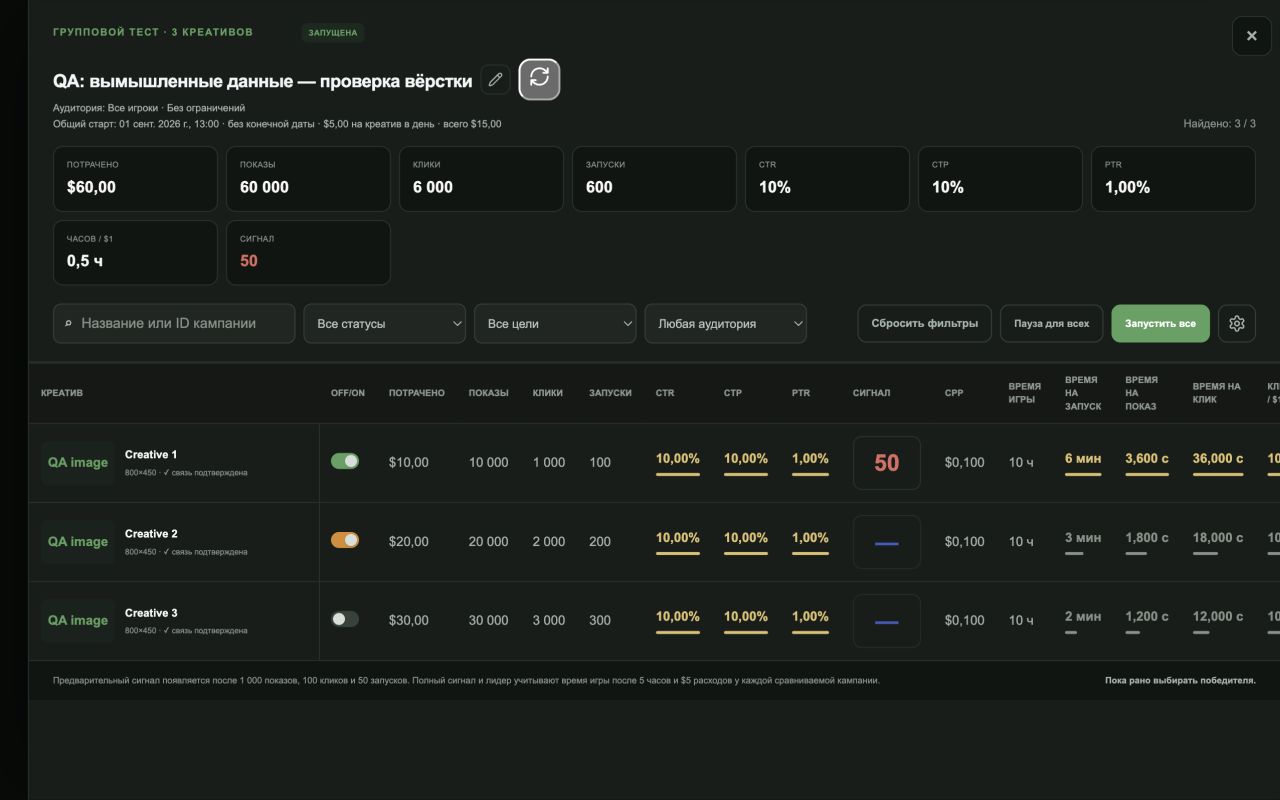
Roblox advertising: when to launch, how to target, and when to stop
A practical Roblox advertising guide: objectives, targeting, budgets, organic traffic, and pause decisions. Real interface screenshots and MARPLA workflows.
Read article
Roblox Ads objectives and audiences: choose for the decision
Connect Plays, Earnings, or Engagement to the campaign question and suitable audience.
Read article
Paid and organic Roblox traffic: avoid attribution errors
Separate Ads Manager, Acquisition, and organic Home when evaluating advertising.
Read article
Discussion0
Loading comments…