
Game analysis
CCU sampling and gaps: when a line is evidence
A public CCU history is a sequence of observations, not a continuous recording. MARPLA schedules bounded market collection, prioritizes watched and newly discovered games, and rotates older records. Roblox rate limits, partial responses, and canceled collection runs can leave gaps. This article expands the [CCU guide](/en/resources/ccu-explained) and the [history feature](/en/resources/ccu-history) with a reproducible coverage check.
Focused deep dive
What the chart actually contains
Each point records the public playing count for one Universe at a specific time. The scheduler may offer a market collection slot every five minutes, but a rotating catalog does not promise one point for every game in every slot. A blank interval is unknown. It is neither zero nor proof that the game was unavailable. The safe unit of analysis is the covered window: the timestamps and observations that exist.
Before computing growth, inspect the latest timestamp, spacing, number of distinct time buckets, and whether both the baseline and comparison windows have enough real points. MARPLA’s current one-hour scout calculation uses the average of the latest 15 minutes against the 45–75 minute window, requires at least two observations separated by five minutes in each window, and rejects a baseline average below three. Those are product rules for that signal, not universal statistical guarantees.
Worked example: a missing peak
Game A has observations at 18:00, 18:05, 18:10, and 19:00: 120, 130, 125, and 210 CCU. Game B has points every five minutes and rises from 120 to 170. It is tempting to say A grew faster, but the fifty-minute gap hides the path. A might have climbed steadily, spiked to 500 and cooled, or stayed near 125 until 18:59. The only supported claims are that A was observed at 125 at 18:10 and 210 at 19:00, and that the end-to-end observed change was +85.
For a comparison, restrict both games to a window with adequate overlapping coverage or wait for another cycle. If the decision is urgent, report A as “possible acceleration, sparse evidence” and make the next observation the decision trigger. Do not draw interpolated points and call them collected data.
Coverage check before interpretation
Save the timestamps with the conclusion so another reviewer can reproduce the window.
- Confirm Universe ID and the newest observation time.
- Count distinct buckets in the baseline and comparison windows.
- Mark gaps explicitly and compare only overlapping covered periods.
- Use absolute change with percentage change and the starting base.
- Schedule a follow-up when coverage can change the decision.
Pitfalls that create false movement
Do not convert a failed or missing request to zero, bridge long gaps as if the path were known, or compare a densely sampled game with a sparse game without qualification. Avoid treating a scheduled interval as a delivery guarantee. A single browser refresh also does not prove that the background collector has completed a new sample.
Coverage solves only one problem. Even a complete CCU series does not identify unique users, retention, source mix, or cause. A regular daily peak may reflect geography and routine rather than a new product effect. Pair the line with Visits increments, updates, chart observations, and owner analytics where authorized.
Decision record
For every cited movement, record the two endpoint timestamps, the observations included in each window, coverage, and the rule used to exclude gaps. Preserve the raw points or export beside the chart. If a later collection fills part of the period, append a new analysis instead of rewriting what was known at decision time.
Primary sources
Put this into practice in MARPLA
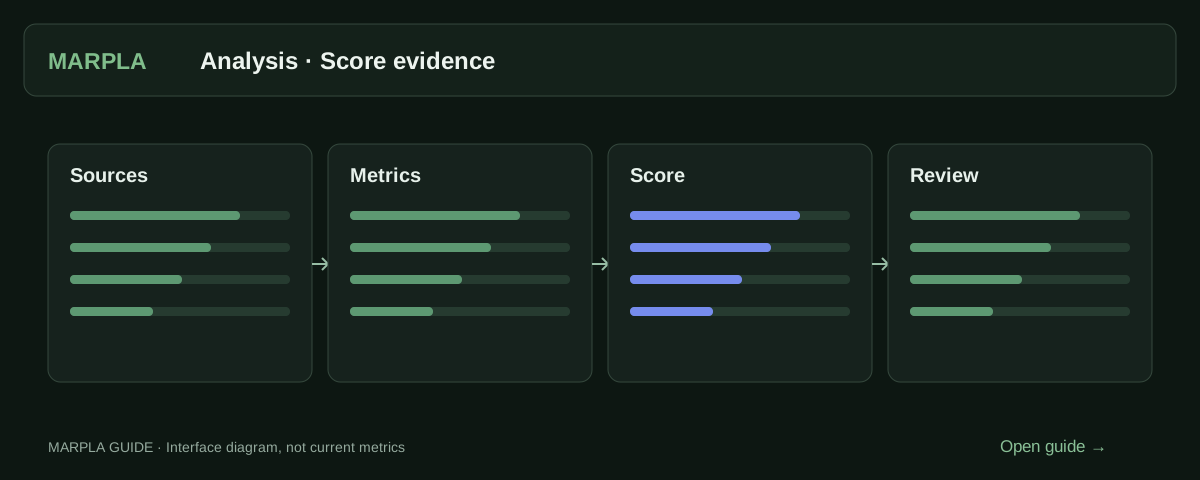
Select a game in Analysis and inspect its sources and score components. Use them to choose your next research question rather than treating the score as a verdict on success.
- Start analyzing a gamePublic analysis helps you explore a game's audience, activity and rating.Step-by-step guide →
- Understand scores and riskScores help you choose projects for a closer look.Step-by-step guide →
Where this deep dive applies
- How to analyze a Roblox game before investing time or money
- CCU, Visits, and growth: what the numbers actually say
- How to compare Roblox games fairly
- Roblox market analytics built from public observations
- Compare Roblox games on the same evidence
- Observed CCU history for Roblox games
- How to find growing Roblox games: signals and a candidate card
- MARPLA public-data methodology and privacy boundaries
Continue exploring
More on this topic →
Observed CCU history for Roblox games
Inspect saved concurrent-player samples with honest gaps, timestamps and range controls.
Read article
CCU, Visits, and growth: what the numbers actually say
Understand Roblox audience metrics without confusing a live snapshot, a lifetime counter, and a measured trend.
Read article
Compare Roblox games on the same evidence
Place selected experiences on shared charts and separate real differences from timing and coverage artifacts.
Read article
Discussion0
Loading comments…