
Game analysis
From watchlist to decision: a Roblox research queue
A watchlist is useful only when every item has a reason, owner, and next decision. MARPLA lets signed-in users save public games, organize comparisons, and keep private scouting stages, notes, contacts, and next-action dates. This workflow connects the [market catalog](/en/resources/market-analytics), [growth radar](/en/resources/find-growing-games), and deeper diligence without turning every signal into an urgent lead.
Focused deep dive
Separate discovery from commitment
Discovery answers whether a game deserves attention. Screening asks whether public evidence survives coverage and peer checks. Diligence asks the owner-only business questions. Decision selects monitor, play-test, contact, partner, or pass. Keeping these stages separate prevents a high score or exciting chart from becoming an unsupported acquisition thesis.
Each card needs a one-sentence thesis, evidence links, observed timestamp, current stage, next action, due date, and removal rule. Use tags or groups for comparable cohorts, not for vague importance. A stale candidate without a new signal should leave the active queue; its archived note can preserve why it was rejected.
Worked example: a candidate that earns contact
A simulation game is detected two weeks after launch. Its supported 24-hour CCU is up 35% from an absolute base of 80, seven-day movement is positive, Visits and favorites are increasing, and the game remains above its prior matched daily cycle. The play-test finds a clear loop and no obvious broken onboarding. The card thesis becomes: “early public growth persisted across three matched cycles; ask whether retention and acquisition support a partnership.”
The next action is assigned for Friday: contact the published studio channel and request a supervised review of new-user D1/D7, source mix, and revenue by product. The removal rule is “pass if growth returns below the prior baseline for two matched cycles or the owner cannot substantiate rights and analytics.” Public evidence justifies contact; it does not yet justify valuation.
Build a queue that closes loops
Review active items on a fixed cadence appropriate to the decision, while keeping the public collector cadence separate.
- Save only candidates with a written thesis.
- Attach timestamps, coverage, comparison peers, and evidence links.
- Assign one next action, owner, and due date.
- Move the card when evidence changes the stage.
- Archive passed candidates with the reason and re-entry trigger.
Queue failure modes
A large unowned Favorites list becomes a second search result, not a workflow. Avoid duplicate cards for the same Universe, indefinite “monitor” states, and notes without dates. Do not let a contact field imply that a person consented to outreach or that a public Discord identity is the decision maker.
The collector may update data more often than a human should change a decision. Reacting to every point encourages noise chasing. Define the decision window first. Protect private notes and deal stages; public catalog facts and private negotiation context belong to different access layers.
Decision record
A complete card can be read without reopening the full catalog: thesis, evidence, source times, coverage, stage, private owner, due date, next action, and removal rule. Review overdue cards first and archive those whose thesis no longer has a path to a decision.
Primary sources
Put this into practice in MARPLA
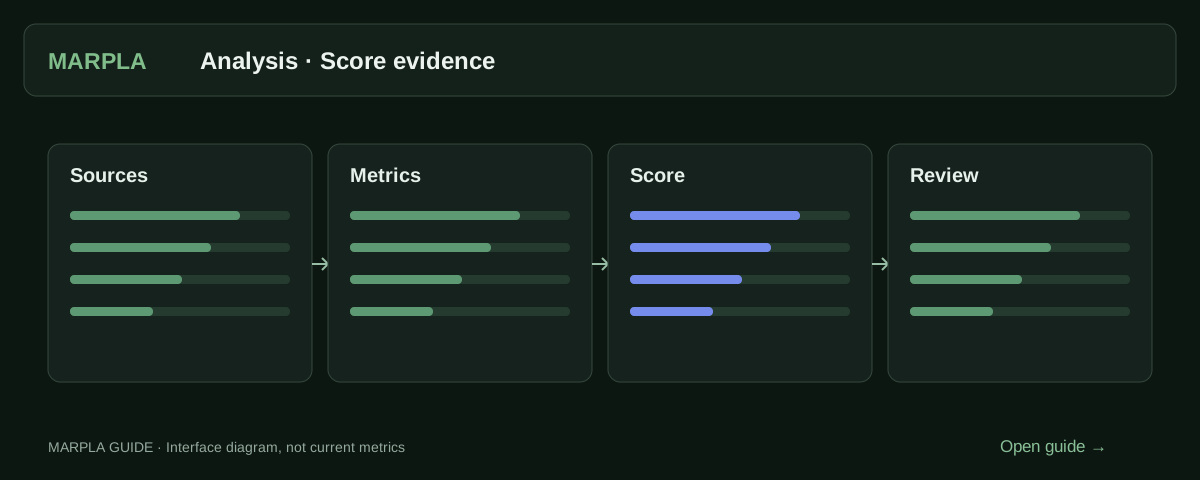
Select a game in Analysis and inspect its sources and score components. Use them to choose your next research question rather than treating the score as a verdict on success.
- Start analyzing a gamePublic analysis helps you explore a game's audience, activity and rating.Step-by-step guide →
- Understand scores and riskScores help you choose projects for a closer look.Step-by-step guide →
Where this deep dive applies
Continue exploring
More on this topic →
Roblox market analytics built from public observations
Track public Roblox experience signals in one catalog while keeping owner-only analytics separate.
Read article
How to find growing Roblox games: signals and a candidate card
Shortlist growing Roblox games using CCU trends, history, and data coverage. Includes a candidate card, repeat checks, and limits of public analytics.
Read article
How to spot sustainable Roblox growth instead of a temporary spike
Use several time windows, supporting counters, and peak preservation to distinguish a rising baseline from a short burst.
Read article
Discussion0
Loading comments…