
Game analysis
Owner analytics diligence: access, evidence, and scope
Public research should produce a short list of questions that only the owner can answer. Diligence then verifies those questions through authorized analytics, dated exports, and supporting records. This article extends [public vs owner analytics](/en/resources/public-vs-owner-analytics) without asking for broad credentials or treating screenshots as complete evidence.
Focused deep dive
Request evidence by decision, not by dashboard
Define the decision and material claims first: audience quality, revenue durability, acquisition dependence, update impact, or partnership readiness. Map each claim to the smallest dataset: daily DAU and new users, cohort retention, session time, acquisition sources, payer conversion, revenue, refunds, product sales, technical performance, or funnel events. Record the metric definition, time zone, filters, period, and export time.
Roblox limits analytics access to the owner and group members with sufficient permissions. Prefer a supervised review, a role with the minimum necessary permission, or dated exports. API keys must have only needed scopes and should not be pasted into chat, email, or a document. Access proves permission to view; it does not prove that the selected range or definition supports the claim.
Worked example: verifying “growth is organic”
A public curve shows CCU doubling over four weeks. The owner says growth is organic. Ask for acquisition by source over the same four weeks and the matched prior period, plus new-user D1/D7 retention and spend by cohort. Suppose the export shows Sponsored Ads fell from 60% to 20% of new users while Home and Search grew, and new-user retention stayed within a stable band. The claim now has support, though “organic” still needs a stated source definition.
If only a cropped revenue screenshot is supplied, it cannot resolve acquisition or cohort quality. Record the claim as unverified and request the specific export. If the owner cannot share it, the business decision must price that uncertainty rather than silently replace missing data with public CCU.
Run a minimum-access review
Keep a request log so both sides know which claims have been verified.
- List material claims and the decision each affects.
- Map every claim to a metric, period, filter, and source.
- Use supervised review, narrow roles, or dated exports.
- Reconcile totals across statements, analytics, and public observations.
- Remove access when the review ends and record unresolved items.
Security and evidence failures
Do not request passwords, cookies, recovery codes, or unrestricted keys. Avoid forwarding tax, identity, or player-level information beyond the people who need it. A screen recording can show a dashboard state but may omit filters, time zone, refunds, or later corrections; preserve the export and context.
Private data is not automatically correct or comparable. Changes in metric definitions, attribution, cohort maturity, and time zones can break a comparison. Separate source facts from your inference, and let missing evidence reduce confidence rather than become a zero.
Decision record
For each verified claim, note the authorized reviewer, access method, export time, filters, definition, and retention policy. Keep unresolved claims visible. At closure, remove temporary access and record that revocation without copying secrets into the diligence file.
Primary sources
Put this into practice in MARPLA
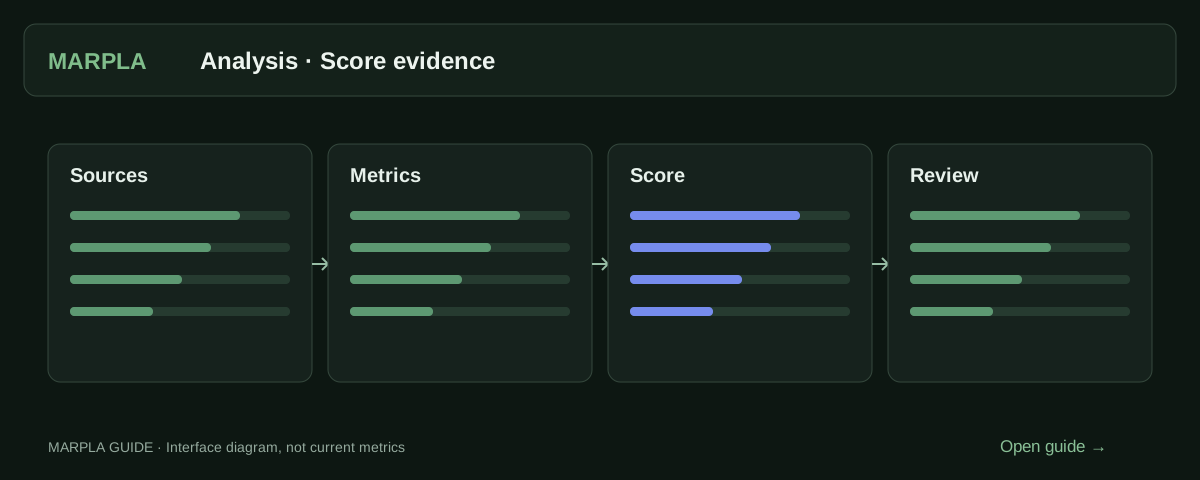
Select a game in Analysis and inspect its sources and score components. Use them to choose your next research question rather than treating the score as a verdict on success.
- Start analyzing a gamePublic analysis helps you explore a game's audience, activity and rating.Step-by-step guide →
- Understand scores and riskScores help you choose projects for a closer look.Step-by-step guide →
Where this deep dive applies
- How to analyze a Roblox game before investing time or money
- How to compare Roblox games fairly
- Public Roblox data vs owner analytics
- Roblox market analytics built from public observations
- Compare Roblox games on the same evidence
- How to find growing Roblox games: signals and a candidate card
- MARPLA public-data methodology and privacy boundaries
Continue exploring
More on this topic →
How to analyze a Roblox game before investing time or money
A repeatable due-diligence workflow that separates public evidence, owner-only analytics, hypotheses, and unanswered questions.
Read article
Public Roblox data vs owner analytics
Know what can be observed from the market, what requires permission, and where public estimates must stop.
Read article
MARPLA public-data methodology and privacy boundaries
Understand sources, sampling, derived metrics, access controls and the limits of public Roblox research.
Read article
Discussion0
Loading comments…