Launch, evaluate and stop advertising
Run a controlled launch, separate paid traffic from organic traffic, and verify that every campaign has stopped.
How to use it
- Open the intended game and advertising account, refresh data, and record one hypothesis, the baseline source, spend limit, and early-stop criterion.
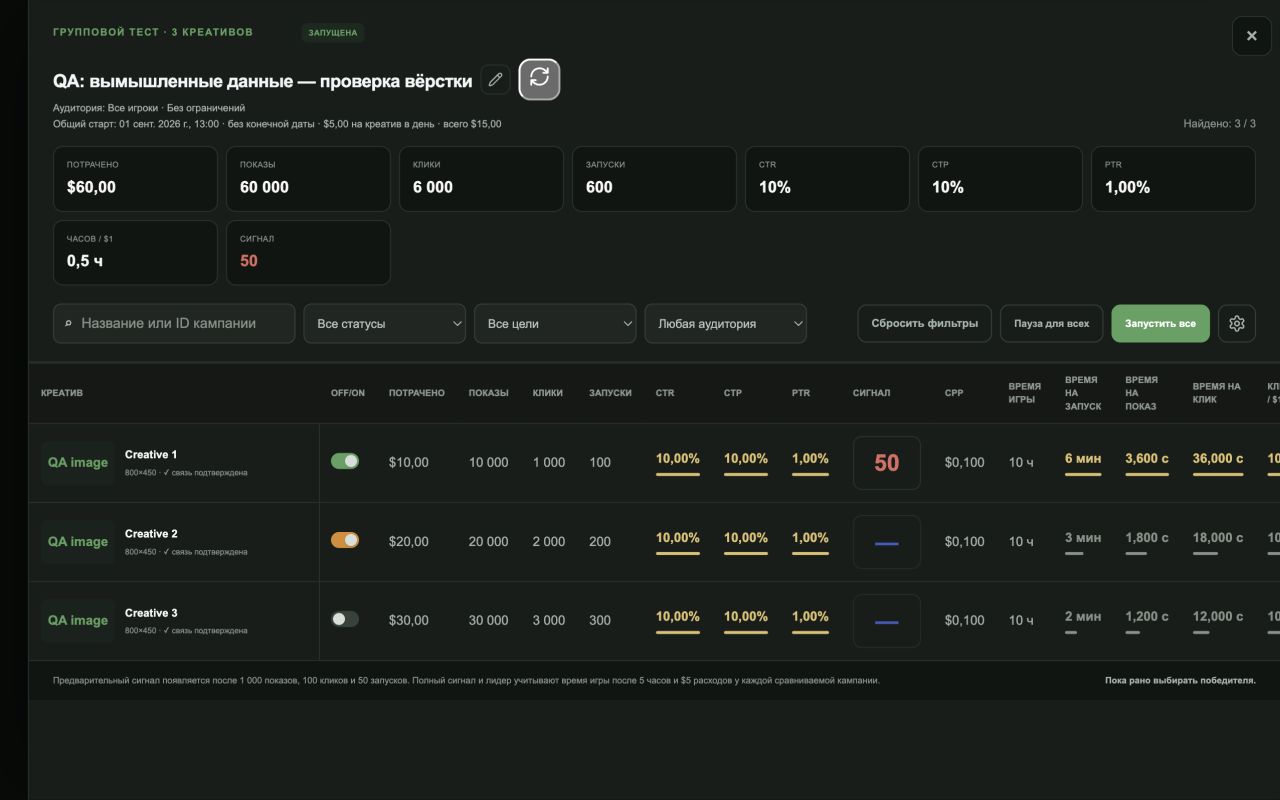
- Create one campaign for one variant or a Creative test for creatives under matched conditions. Before confirmation, check the game, account, permissions, budget, dates, objective, and audience; a Manual group only combines existing campaigns.
- After a confirmed launch, check serving, coverage, period, and reporting. Use local Signal and per-dollar metrics only to compare rows in one window; do not call them profit or an effect on organic RFY.
- Assess a mature comparable window, not the first hours; stop earlier for an error, moderation, or spend-limit risk. For a group, choose Pause all and wait for every campaign confirmation, then separate the historical snapshot from current status and the paid cohort from organic traffic.
Advice and practical context
Launch without a false promise of organic growth
Advertising in MARPLA is a controllable way to acquire and test an audience, not a purchase of organic Recommended for You placement. Before launch, choose one testable hypothesis and keep objective, audience, budget, and period unchanged wherever creatives are being compared. A standalone campaign suits one variant; a group creates one campaign per creative for several variants. A Manual group combines existing campaigns and does not change Roblox settings. First make sure the first screen and FTUE have no known failure, then record the baseline source, date, spend limit, and early-stop reason. A lower overall D1 after launch does not prove lower organic rank: the paid audience can differ from the organic one. Inspect source, funnel completion, and available organic RFY signals separately.
When to evaluate and how to end a test
The first 24–48 hours can be learning, while post-view playtime and spend arrive with delay. Do not name a winner from the first hours: Roblox usually recommends beginning assessment after 7–10 days. That is not a requirement to wait or keep spending through a technical error, moderation issue, spend-limit risk, or other harm. Within one group and matching period, compare coverage, impressions, clicks, plays, spend, and game quality; Signal remains a local row comparison and its sample minimums are not a budget goal. Per-dollar metrics describe spending efficiency, not profit without confirmed revenue and all costs. When stopping, wait for pause confirmation for every campaign. The final snapshot is useful history, but it does not replace current live status or establish causality.
Technical detailsCalculations, permissions and behavior
Smart advertising launch
Practical order: 1) select one game and advertising account; 2) record a testable hypothesis, baseline source, date, spending limit, and early-stop criterion; 3) use + Single campaign for one variant and Creative test for comparison, with one campaign per creative; 4) before confirmation, check the game, `ads.campaigns.manage` permission, objective, amount per creative, dates, and account; 5) after launch, synchronize and wait for confirmed status and delivery status; 6) treat the first 24–48 hours as possible learning when there is no error, moderation, spend-limit risk, or other harm; 7) within one group and period, compare only rows with comparable coverage; 8) interpret Signal as a local comparison and per-dollar metrics as spending efficiency, not profit; 9) to stop, choose Pause all and wait for confirmation for every campaign. + Single campaign creates a separate campaign for one variant; Creative test creates one campaign per selected creative. A Manual group only combines existing campaigns in MARPLA and neither creates Roblox campaigns nor changes their budget or targeting. A successful list sync does not prove campaign-write access.
Signal 0–100 is not a rating of every campaign and does not prove causality; its sample minimums are not a budget target. Per-dollar metrics divide events or attributed playtime by spend for that campaign in the same window and do not mean profit without confirmed revenue, fees, and other costs. On stop, MARPLA first saves a final snapshot and then requests a pause for each campaign; consider the stop complete only after Roblox confirms every status.
The saved stop result remains a historical snapshot and does not replace current statuses.
Learning, reporting, and decision
Reports may not receive every metric at once: post-view playtime and spend/revenue can be revised later. Compare a complete matching period and record coverage, warnings, and retrieval time instead of treating absent values as zero. Roblox usually advises starting performance assessment after 7–10 days; that is guidance for a mature normal test, not a duty to spend or wait through an error.
For interpretation, separate the paid cohort from organic traffic. A lower overall D1 after launch can result from mixing colder paid traffic with another audience. It does not prove that advertising damaged organic RFY rank: inspect source, funnel quality, and available organic RFY signals separately.
Traffic mix and an advertising milestone help frame the next test, but they do not change Ads Manager or establish causality.
Stop and record a test
Before stopping, record the test question, period, variants, matched settings, spend, and data boundaries. In a group, Pause all requests a pause for every created campaign; if any operation is not confirmed, the group remains partial and its error list shows what to check. Do not call a test stopped merely because a button was selected or a card was saved.
After confirmation, use the final snapshot for history and open current data separately if campaigns change later. Keep the next action narrow: retain a variant, replace one creative, change one targeting choice, or repair one funnel step. Do not transfer a group result to another audience, budget, period, or game without a new testable launch.
Useful articles: examples and decisions
The guide covers the steps in the service. These articles explain the metrics, examples, techniques and how to evaluate results.