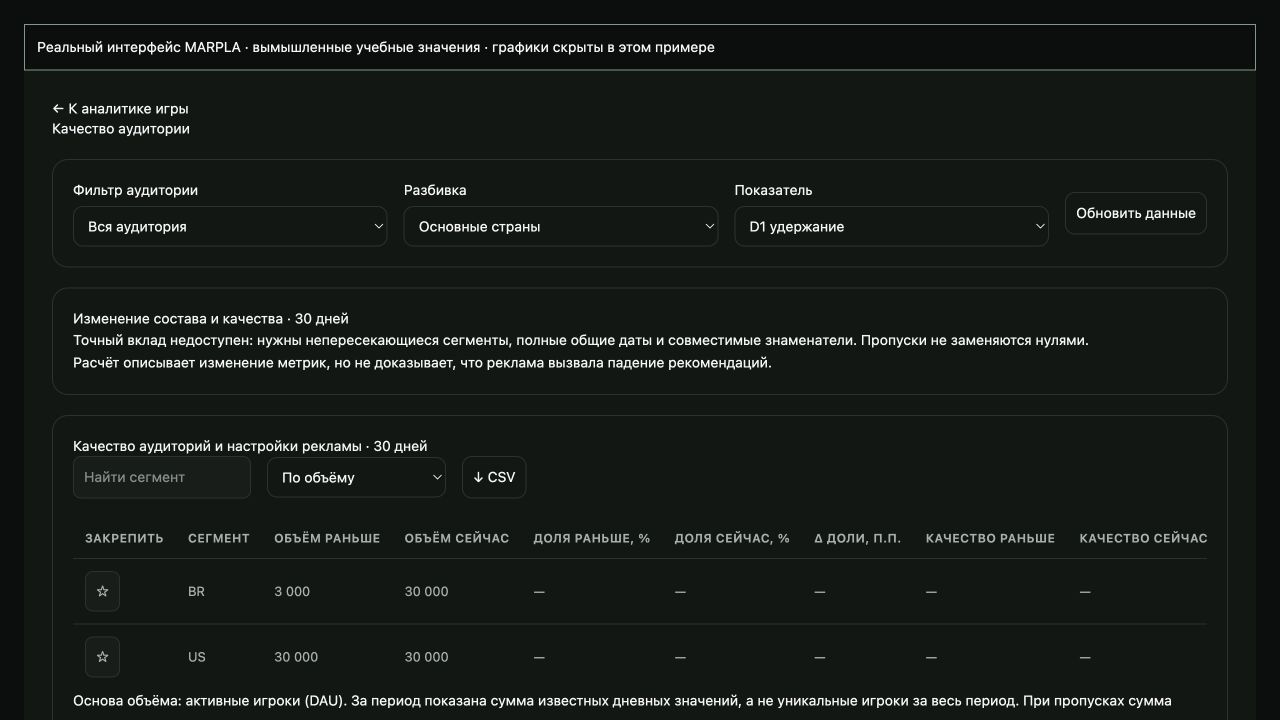
Compare Home creatives and sets
Distinguish set changes from statistics days.
How to use it
- Below the general table, Set performance over time compares all known sets in the selected dates, each in its own colour. Select a metric, date preset, day/week/month step, display mode, lines and milestones. Set exact dates above the table. AI advice sits to the right of the chart heading and follows the selected metric. The connected chart has one overall total per date. Colour indicates the largest impression contributor; tooltips show totals and set contributions. Replacement-day counts are added before recomputing ratios; pink dashes mark gaps. Table search and pagination do not hide lines.
- Sets and changes lists saved compositions separately. The table shows the Roblox creation date; the set heading shows creation and completion with UTC times. Unknown dates use a dash. Earlier creatives without complete history are marked separately; exact times are not invented.
- Open a set for its totals and separate creative lines. Escape or clicking outside the drawer returns to the same list position, preserving its page, search, status filter and sorting. Statistics days appear below the figures. Select a range, metric and lines; select a column heading to sort.
- Late reports and ambiguous days for reused images remain in All Roblox data. They do not extend the set's operating dates. Open a milestone for Before → After thumbnails.
Files and links
Roblox Home thumbnail metricsRoblox metricsAdvice and practical context
Compare equal periods
A creative can have several serving intervals, and an intraday change does not split daily statistics. Compare variants on matching complete periods and account for impression volume. QPTR is plays divided by impressions, while average session is weighted by plays.
Winner and uncertainty
A variant with higher QPTR on few impressions can lose after broader exposure. Inspect 7D signals and winning segments separately for each creative and set. Do not treat a gap as deactivation or assign a whole day's result to an image enabled midway through that day.
A winning segment does not imply an overall winner: a creative can work for one audience and underperform for another. Define the target segment first, then inspect total volume and guardrails. Keep a set and its individual image as separate analysis objects.
A new country and blended averages
During Home expansion, separate audience composition from within-segment quality. Check source, equal cohort maturity, country and an available device breakdown. D1 cannot be weighted using DAU. New organic RFY traffic contributes to Home signals, so not every decline is harmless. Investigate translation, loading and the first step; relate dates to Home history and notes. Useful articles provides a detailed guide and examples.
Technical detailsCalculations, permissions and behavior
Compare Home creatives and sets
Content → Home lists saved set compositions. The Created column shows the Roblox set creation date without a time. The opened set header shows Created and Completed dates and times in UTC.
Replacing its images does not change the set creation date. Member rows show their set's creation date. Observation or sync times are never presented as creation or completion.
Unknown dates use a dash; active sets have no completion date. Sync saves Roblox corrections to completion dates. Earlier images known only from statistics do not receive invented set dates.
Open a set name: its name and dates appear in the top heading, followed by totals, members and separate creative chart lines. Press Escape or the area outside the drawer to return from a creative to its set, then to the list. The chosen period is retained.
Returning to the main list also restores its scroll position, page, search, status filter and sorting. Use period and metric controls, filters, search and sorting to compare results. Each summary figure shows the days contributing to its value.
Impressions and qualified plays are totaled; QPTR is qualified plays / impressions, and session length is weighted by qualified plays. Incomplete totals have an asterisk. A reused image's daily result cannot be divided between intraday runs.
Ambiguous days and late reports after deactivation do not extend a set. 7D QPTR and winning segments are not added together. Signal compares QPTR on shared dates with sufficient data; it is a guide, not proof of a winner. Milestones show saved changes with Before → After thumbnails.
Viewing or syncing history does not change active Roblox images. Set performance over time appears below the general table: every known set has a persistent colour and thumbnails. It includes all sets in the chosen date range, independently of table search, status and pagination; choose lines in the legend.
Controls include impressions, qualified plays, average session and QPTR, date presets, day/week/month steps, straight/smooth lines and bars, milestones, tooltips, AI advice and refresh. The guide icon sits next to Set performance over time or Performance over time, and AI advice appears below it on the left. The selected metric title is not repeated; advice follows that metric and the open set or creative.
Set exact dates above the table; the chart does not repeat those fields. Larger steps first total source counts, then calculate QPTR and weighted session length. A weekly or monthly point uses its first available data day.
Line and smooth modes always show a single overall timeline: one total per date, including earlier creative evidence. Counts from both sets on a replacement day are added before recalculating QPTR and weighted session length. Colour identifies the largest impression contributor in that day or larger bucket; it does not indicate an exact switch time.
Tooltips show the overall total and set contributions with their image thumbnails. Rows without a value on the selected date are hidden; zero values remain visible. A short first day no longer restarts a separate line near zero.
Missing dates have pink dashed connections without fabricated observations. Bars show separate set series. Inside a set, the chart still contains only its own creative lines.
The set list, the overall creative list and each set's creative table have independent sorting. Closing a set restores the list's own order; reopening the set preserves its member sorting. Average session, QPTR, 7D QPTR and Signal use colours relative to the best available value in that column: at least 95% is green, at least 80% amber, below that red.
Sorting and pagination do not change the comparison base. Missing, single and identical values remain neutral. Colour helps read the table; it does not indicate statistical significance, and different sets may cover different dates.
Signal still requires shared dates and a minimum display sample, which does not prove a winner. AI reviews creatives by exposure and effect size, without a mandatory seven-day wait. New assignments include up to 90 completed days of saved Home history: each composition, its members, shared dates, impressions and qualified plays, and previous occurrences of proven copies of the same image.
Advice must name the baseline conversion, worthwhile improvement, actual sample and next per-variant exposure checkpoint. At a 1% baseline, approximate impressions per variant are 42,693 for 1.2%, 7,750 for 1.5%, and 2,319 for 2%. This plans independent observations, equal allocation, one preplanned comparison, 5% error and 80% power; it does not prove significance for the current set.
There is no universal click or play count. Home provides qualified plays, not per-thumbnail clicks. Roblox personalization changes audience mix and exposure shares, so ranks and QPTR intervals are descriptive.
AI must consider winning segments and conflicting prior runs, without pooling different or overlapping tests. When a large gap and sample support action, it can propose the next test now: a strong control plus new candidates to confirm and improve. It may shortlist one, two or three observed leaders while retaining close and segment-specific alternatives.
A single control candidate does not mean leaving only one active image. If evidence is weak, advice states the missing exposure; an ETA requires an observed traffic rate. Mean session without dispersion does not establish audience quality.
Short creative review horizons in new assignments do not change price safeguards or older downloaded assignments.
Useful articles: examples and decisions
The guide covers the steps in the service. These articles explain the metrics, examples, techniques and how to evaluate results.
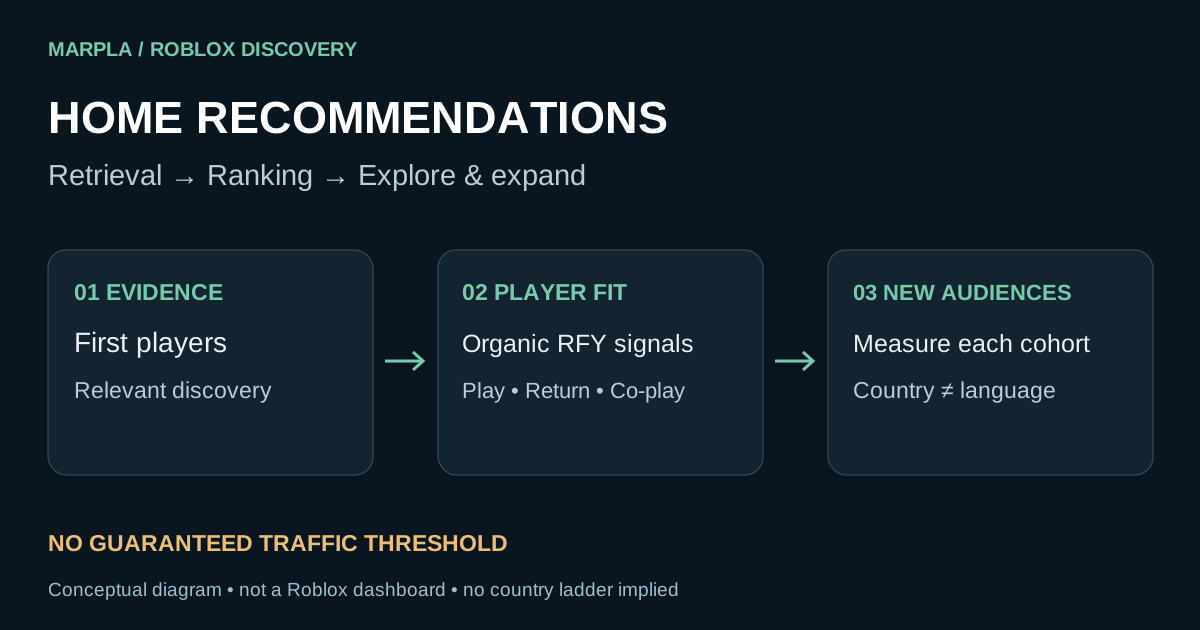
Roblox Home recommendations: get discovered and sustain growth
How Roblox tests and expands Home recommendations, what signals matter, and how to diagnose country mix and falling metrics with MARPLA.
Read article →
Roblox thumbnails: screenshots, staged scenes and practical testing
Choose Roblox thumbnails, structure the game-page gallery and test Home images: screenshots versus renders, PTR/qPTR, creative briefs and a practical workflow.
Read article →Action essentials and individual concepts (9)
 Roblox Home recommendations: action plan
 Roblox thumbnails: a short working plan
 Roblox Home PTR and early exits: find the weak stage
 Roblox country cohorts: explain audience-mix changes
 Roblox localization and performance: diagnose early exits
 Paid and organic Roblox traffic: avoid attribution errors
 Roblox creative brief and gallery: promise to sequence
 Roblox Home thumbnail personalization: read an adaptive test
 Roblox launch cohorts: measure an update without mixing sources